Breaking News
Breaking News
from Washington and beyond

The California Shootings Are About Race, but Not in the Way You Might Think

The suspects in two back-to-back shootings in California are Asian men. But focusing on the gunmen’s race alone, without understanding the greater context of gun violence in America, doesn’t help anyone.

Someone wearing a mask holds a sign that reads "What about gun control?" and a candle. Others around him also hold candles.
Sarah Reingewirtz/MediaNews Group/Los Angeles Daily News/Getty Images

The Asian American community is reeling from two consecutive mass shootings in California that targeted mostly Asian spaces. The tragedy has been made all the more difficult by the revelation that both gunmen were older Asian men.

Many on the right have been quick to seize on this detail, with Donald Trump Jr. accusing media outlets of failing to cover the massacres because they don’t “work for the narrative” of white supremacy. This isn’t true: The story was covered extensively by most major media outlets, but that didn’t stop people from amplifying the lie.

There are real reasons to talk about race when looking at what happened in California. The two shootings have compounded the trauma of Asian American communities, who have already been suffering from a meteoric rise in anti-Asian rhetoric and crimes the last few years, fueled in large part by Trump Jr.’s father, former President Donald Trump, and his language about the Covid-19 pandemic.

The gunmen’s race is an anomaly when looking at the history of mass shootings in America. But focusing on their race alone, without taking into account the larger context of gun violence in the country, does us a massive disservice.

“Multiple factors can be true, and one does not negate the other,” said Cynthia Choi, the co-executive director of Chinese Affirmative Action and the co-founder of the coalition Stop AAPI Hate.

But “in America, race always does matter,” she told The New Republic. “We have had to deal with multiple forms of hate and violence, and that includes coming from outside the community, within the community, amongst our other community members.”

Huu Can Tran, 72, is suspected of looking for his ex-wife when he killed 11 people and injured nine others in Monterey Park. Chunli Zhao, 66, is believed to have been targeting his workplace when he killed seven people and wounded another in Half Moon Bay. We may never know their true motives, but the suspected ones are completely typical for mass shooters in the U.S.

Tran and Zhao also are not the only senior Asians to commit mass shootings: In May 2022, 68-year-old David Chou entered a church in Laguna Woods, California, that was hosting a congregation from the Irvine Taiwanese Presbyterian Church and opened fire, killing one person and wounding five others.

These three shooters indicate a chilling trend of increased radicalization among older Asian Americans.

Sylvia Chan-Malik, a professor of American Studies and Women, Gender, and Sexuality Studies at Rutgers University, said Asian elders increasingly get their news from videos—either found online or shared through chat platforms such as WeChat—instead of Asian-language newspapers.

“They’re kind of engaging the same media landscape” as the rest of us, which is increasingly digital, she explained to TNR. “Except because of the limited range of media they can consume because of language barriers, YouTube and these content creators become the primary source of a lot of their media consumption.”

Algorithms feed viewers suggestions, which include videos rife with mis- and disinformation tailored specifically for immigrant communities. “And all of a sudden, it’s not really news, it’s ideology,” Chan-Malik said, noting she’s “found that this is true across all sorts of communities of color.”

She also pointed out that Asian immigrants come from a wide variety of backgrounds, but they are all being convinced there is truth in extremist views.

But Tran, Zhao, and Chou’s jump from ideology to action is unusual—and uniquely American. The Asian American Pacific Islander, or AAPI, community has one of the lowest rates of gun violence in the U.S., and almost 60 percent of those gun-related deaths are suicides. This tracks with gun-related deaths in Asian countries, which have low rates of mass shootings.

A major difference is how easy it is to acquire a firearm in the U.S., as well as the spread of ideology around guns.

“What we’ve seen in the last couple of years is people mainstreaming the idea that guns keep us safe. It’s not true,” said Josh Horwitz, the co-director of the Johns Hopkins Center for Gun Violence Solutions.

Gun regulations vary by locale nationwide, making it easy for someone to slip through one state’s tight restrictions and purchase a firearm elsewhere, as was the case in Monterey Park. What’s more, after a mass shooting, gun sales actually increase as people fear for their own safety and believe owning a gun will protect them.

Mass shootings are most often the result of “pure, individual grievances,” Horwitz explained to TNR. Some, such as the shootings in Buffalo or El Paso, are fueled by clear-cut white supremacist ideology. But there’s a litany of other reasons, from perceived injustice to relationship problems and domestic violence. Authorities in Half Moon Bay say Zhao seemed to be targeting specific individuals.

According to Horwitz, there’s been a “concerted effort” to push the idea that individual force has a place in decision-making, particularly for political decisions.

“We often see very individualized grievances now getting into the idea that guns can solve” those grievances, he said. “There’s too many people who buy into the ideology that guns will keep us safe and save lives. And then in moments when they’re not doing well, they have lots of guns in their hands.”

There have long been calls to tighten gun regulations in the United States. The vast majority of Americans, about 71 percent, support doing so, according to a poll conducted in August by the University of Chicago and the Associated Press. But efforts have repeatedly been blocked by Republican lawmakers.

Unfortunately, race plays a role here too: Opposition to gun control has historically been rooted in racism. In their 2015 paper, “Racial Resentment and Whites’ Gun Policy Preferences in Contemporary America,” University of Illinois Chicago political science professors Alexandra Filindra and Noah Kaplan argue that “racial prejudice colors all aspects of the debate regarding gun policy.”

Not all current gun-control opponents necessarily are prejudiced, but racial prejudice helped give rise to the anti-gun regulation stance.

Post–World War II, gun ownership began being cast as a “right,” according to Filindra and Kaplan. The NRA actually supported gun control until 1977, when the group underwent a leadership change and began actively lobbying for increased gun ownership among Americans.

“We strongly suspect that such a change in gun policy attitudes among whites was possible because guns have been a marker of white privilege throughout American history,” Filindra and Kaplan wrote. For much of its history, the Second Amendment did not even apply to nonwhite people.

None of this, however, can fully explain what drove the gunmen. Instead, at the core of everything is a community that is grieving and struggling to process what happened. After almost three years of fear, this Lunar New Year—one of the most important holidays across the Asian diaspora—was supposed to be an especially fresh start.

Celebrations were planned after being canceled during the first years of the pandemic, and California recently declared Lunar New Year a state holiday.

“Our community is reeling,” Choi said. After the past three years, “we don’t feel safe going anywhere.”

The start of the New Year festivities “was just such a joyful moment,” she said. “And that feels like that was taken from us once again.”
Oil Refineries Dumped More Than a Billion Pounds of Chemicals in Our Water in 2021

A new report says the Environmental Protection Agency is failing to enforce the Clean Water Act, as oil refineries continue to poison American waterways.

LOIC VENANCE/AFP/Getty Images

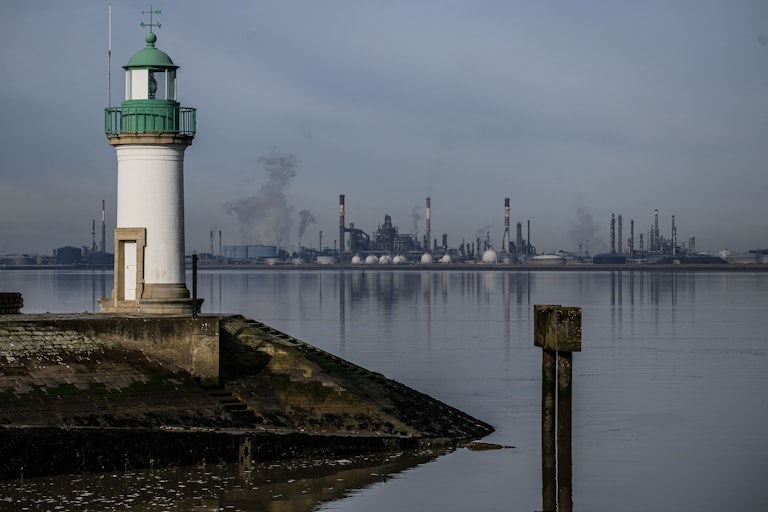
We are looking down the barrel of a worldwide mass plant and animal extinction. And yet the U.S. government continues to let fossil fuel interests treat our planet, and us, like garbage. A new report says the Environmental Protection Agency is failing to enforce the Clean Water Act, allowing U.S. refineries to pour half a billion gallons of wastewater every day into waterways. According to the Environmental Integrity Project report, this resulted in upward of 1.6 billion pounds of chemical waste poisoning American waterways in 2021.

These chemicals are incredibly harmful to wildlife—to their reproductive systems, food and oxygen sources, and even biology. In just one example, a Bay area minnow, more than 80 percent were found to have spinal deformities due to selenium pollution, a chemical that has been dumped to the tune of tens of thousands of pounds in American waterways.

About 68 percent of the refineries examined in the report dumped into waterways designated as impaired—as in, these waters were already so polluted that they were not permitted to be used for fishing or swimming, or were not healthy for aquatic life.

The refineries are also notable sources of so-called “forever chemicals,” or PFAS, that have been linked to things like cancer, endocrine disruption, and fetal development complications. Refineries that have been specifically sampled for PFAS show alarming results: In 2020, a Colorado facility had a concentration of a PFAS variety 14,000 times higher than the EPA’s limit for drinking water.

The Clean Water Act directs the EPA to limit discharge of harmful refinery pollutants and to tighten those limits at least once every five years if possible. Instead, the report says, those standards have not been revised since 1985. Many chemicals are left unregulated, and many potential new innovations to enforce possible regulations are left untouched. And the EPA is remarkably failing to act in accordance with whatever authority it has now.

Records showed that nearly 83 percent of examined refineries exceeded permitted limits on water pollutants at least once between 2019 to 2021; this was a total of 904 violations involving excess dumping of cyanide, ammonia nitrogen, sulfide, oil and grease, and more. Only about 15 violators were penalized. One culprit, the Phillips 66 Sweeny Refinery near Houston, Texas, exceeded its permitted pollution limits 44 times (42 of which involved cyanide) from 2019 to 2021. The facility was penalized just $30,000.

“I have personally witnessed the dumping of untreated plant water into the southeast Texas watershed, which unfortunately drains into the Gulf of Mexico. The very waters upon which we depend for jobs, food, and recreation become more polluted every passing day,” said John Beard, founder and executive director of the Port Arthur Community Action Network. “If water truly is life, what will become of us when there’s no more clean, living water?”

Florida Panel Recommends Forcing Student Athletes to Give Schools Their Menstrual History

The Florida High School Athletics Association said student athletes should be required to give detailed information about their periods when they register to play.

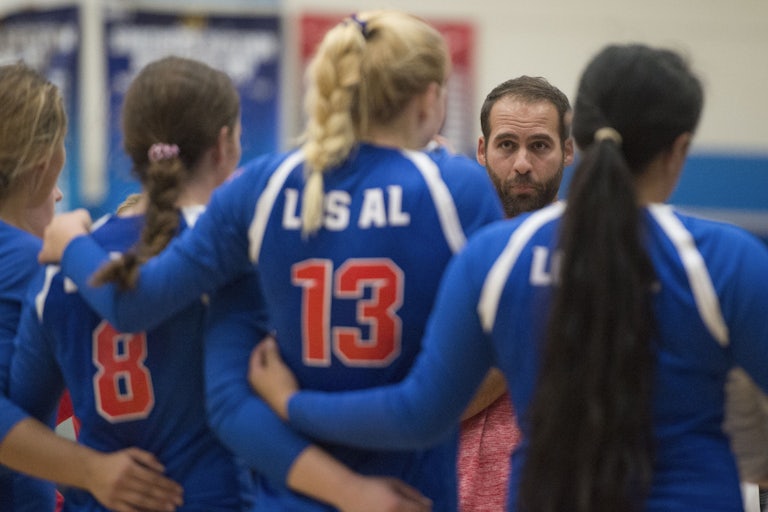
Four girls wearing volleyball jerseys link arms as their male coach looks on
Kevin Sullivan/Digital First Media/Orange County Register/Getty Images

The Florida High School Athletics Association is standing by its decision to require student athletes to give their schools detailed information about their periods, an unprecedented policy that is raising major concerns about privacy.

The FHSAA announced in October that it was changing its annual physical form for student athletes to a digital version instead of paper. The form includes optional but detailed questions about students’ menstruation cycles, including when they got their first period, when they had their most recent one, and how many weeks pass between periods. Previously, only one page of the paper form—on which a pediatrician would sign off on a student being allowed to play—would be submitted to a school. But the entire digital form will now be submitted.

Despite widespread public outcry, an FHSAA panel not only decided Tuesday night to stand by that change but also recommended the menstrual history questions be made mandatory.

The recommendation now goes before the FHSAA board of directors, which will meet in late February to make the final decision.

While students’ medical history is necessary for doctors, it is entirely unclear why a school needs all of that information—or what it would plan to do with it.

“I don’t see why (school districts) need that access to that type of information,” said Dr. Michael Haller, a pediatric endocrinologist in Gainesville with two teenage children.

“It sure as hell will give me pause to fill it out with my kid,” he told The Palm Beach Post when the decision was first made in the fall.

Since the fall of Roe v. Wade, people have been hypervigilant about third parties tracking menstrual data. Period tracker apps and the platform that hosts Florida’s new digital athletics form are not owned by medical institutions and therefore are not subject to health privacy laws. If subpoenaed for someone’s data, particularly in a state where abortion has been made illegal, companies would be required to hand it over.

Florida has made it clear it is cracking down on the rights of women, girls, and gender minorities. The state has banned abortion after 15 weeks, forbidden transgender girls from playing on girls’ sports teams, and barred state residents from using Medicaid to pay for gender-affirming treatments.

Many parents and doctors are worried that schools will use the menstrual data to monitor students for late or missed periods, a possible sign of pregnancy, or to out transgender students by watching for girls who don’t get periods or boys who do.

School administrators say the information will stay private, but there’s no guarantee it will. It’s a terrifying glimpse of our dystopian post-Roe world.

DirecTV Drops Newsmax, and Republicans, Always Focused on What Matters to Americans, Throw a Tantrum

DirecTV says it dropped Newsmax because of the high fees. You wouldn’t know that from the way Republicans are talking about it.

Anna Moneymaker/Getty Images

Television programming company DirecTV has dropped Newsmax, a far-right network, from its channel listing because of a fee dispute.

DirecTV said in a statement that they “made it clear to Newsmax that we wanted to continue to offer the network,” but that “Newsmax’s demands for rate increases would have led to significantly higher costs” the company would then feel compelled to pass on to their customers. The company went even further, plugging the outlets people could still pursue (even for free) if they still wanted to get their Newsmax fix.

In other words, the company’s decision does not seem, at least publicly, motivated by some ideological stand against misinformation or extremism. While DirecTV did drop conspiratorial network One America News last year because of its propagation of misinformation, the dropping of Newsmax appears to be just business.

Nevertheless, Republicans, both elected officials and media personalities, are doing everything they can to stir up outrage and conspiracy to make it seem like Newsmax was exercising more than just ostensible financial diligence.

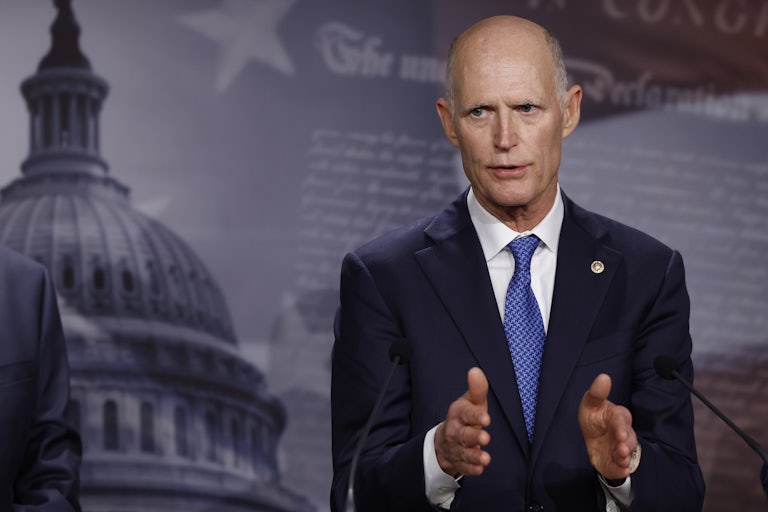
Already, Representatives Michael Waltz and Jeff Van Drew and Senator Rick Scott have called for hearings into the company. Newly elected Monica De La Cruz has spent some of her inaugural time on the House floor to complain about the situation, calling it “another victory in the woke left’s efforts to cancel conservatives and limit free speech.”

De La Cruz’s concerns for free speech came the same week fellow Republican Florida Governor Ron DeSantis rejected an African American history class and public school teachers are removing books from their classrooms to comply with a Desantis-backed law that threatens felony prosecution.

All the while, the U.S. hurdles toward a debt crisis that could upend the global economy.

People can’t afford to go to the hospital, can’t go out in public without fearing being shot to death, and struggle to find an affordable place to live. Meanwhile, Republicans are using their precious time (that we pay them for!) to make people mad about something that never happened. Just another day in America.

Trump’s Facebook and Instagram Accounts Will Be Reinstated, Meta Announces

Trump will be getting his accounts back two years after he was banned for inciting violence on January 6.

Donald Trump
Joe Raedle/Getty Images

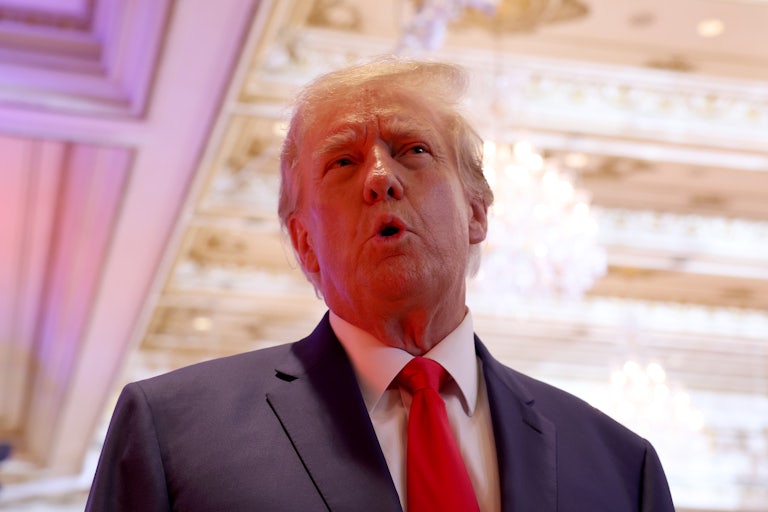
Donald Trump will be reinstated on Facebook and Instagram in the coming weeks, after a two-year suspension, parent company Meta announced Wednesday.

The former president was banned from the social media platforms following the January 6 insurrection, over accusations that his posts helped foment the violence in Washington, D.C., that day.

The public should be able to hear what politicians are saying so they can make informed choices,” Meta President of Global Affairs Nick Clegg said in a statement explaining the decision to allow Trump back online.

“We’ve put new guardrails in place to deter repeat offenses.”

One of those guardrails is Facebook’s independent Oversight Board, a panel of 20 people that helps with content moderation. The board upheld Trump’s initial suspension from Facebook but switched it from indefinite to two years long.

In theory, Trump will be held to the same standards as every other Facebook user when it comes to what he shares on the platform: Content is removed if it causes public harm. But if a Trump post qualifies as “newsworthy”—meaning Meta deems it provides more to public interest than causes harm—it could be left up.

Trump’s reinstatement means that he will be able to resume using Facebook to fundraise for his 2024 presidential campaign.

Meta’s decision to let Trump back on comes a few months after Elon Musk let the former leader back on Twitter. Prior to his suspension on Twitter, Facebook, and Instagram, Trump had gotten in trouble multiple times for sharing misinformation.

Trump has yet to post on Twitter since being allowed back on and has stuck to his Truth Social platform instead. But he is reportedly planning a grand reentry to his once favorite social network.

Trump has 34 million followers on Facebook and 23 million followers on Instagram, and he has previously spent millions on Facebook ads. Many experts worry that his being allowed back on social media will increase the spread of misinformation, particularly as the United States gears up for the 2024 election cycle.