Breaking News
Breaking News
from Washington and beyond

Kentucky Supreme Court Leaves Near-Total Abortion Ban in Place

The court will not allow abortions to resume in the state, sending the question back to a lower court.

Protesters encourage voters to vote no on a ballot initiative that would add a permanent abortion ban to Kentucky's state constitution, on the steps of the Kentucky State Capitol on October 1, 2022.

The Kentucky Supreme Court ruled Thursday to keep a near-total ban on abortions in the state until a lower court can decide whether or not the law is constitutional.

Kentucky currently only allows abortions to save the life of the pregnant person, under a trigger law that kicked into effect when Roe v. Wade was overturned. A separate ban prohibits abortion after six weeks, before many people even know they are pregnant.

Judge Mitch Perry had halted both laws in July, arguing they violated the state constitution’s right to privacy and self-determination. Just weeks later, Appeals Court Judge Larry Thompson overturned the injunction. Lawyers for Planned Parenthood and EMW Women’s Surgical Center, Kentucky’s two abortion providers, filed a lawsuit asking the state Supreme Court to reinstate Perry’s injunction.

The high court heard arguments for the case a week after the midterm elections, when Kentucky residents voted against amending the constitution to explicitly say that it does not protect the right to abortion.

Justice Debra Hembree Lambert wrote in Thursday’s majority opinion that Perry’s court had “abused its discretion by granting the abortion providers’ motion for a temporary injunction.”

The ruling comes the day after a Republican lawmaker introduced a bill that would let the state prosecute a person who gets an illegal abortion for criminal homicide. The proposed legislation was so controversial that it even drew pushback from Kentucky’s anti-abortion Attorney General Daniel Cameron, who said it “strikes the wrong balance” and called on the state legislature to reject it.

Cameron, a Republican who is running for governor, warned the bill would wrongly target women who terminate pregnancies. However, he also defended the other two abortion bans at question in the case before the Supreme Court.

An Experimental Male Birth Control Pill Was 100% Effective. It’s About Time.

Researchers say an on-demand, non-hormonal male contraceptive pill could be a real possibility.

JIM WATSON/AFP/Getty Images

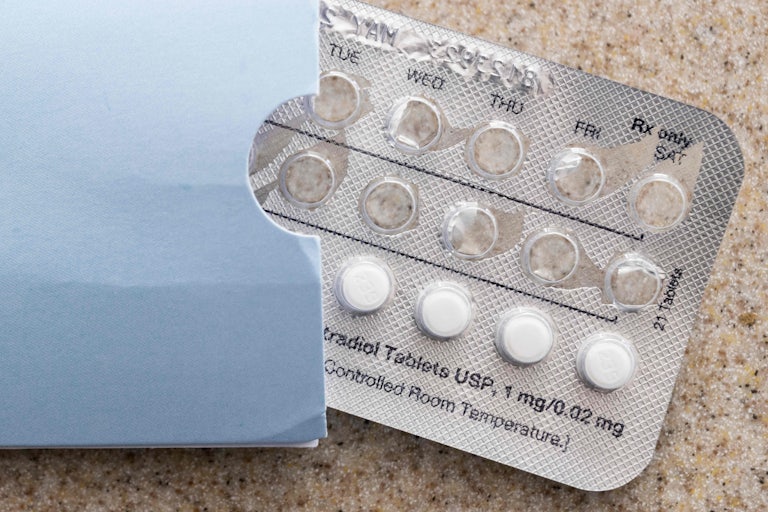
An experimental male birth control was found to be 100 percent effective in a study on mice, paving the way for more equitable contraceptive options.

The pill works by preventing sperm from swimming long enough to reach the egg. The study, published Tuesday, found the medication is 100 percent effective for up to an hour after being taken. The pill’s effectiveness dips slightly to 91 percent after three hours, and falls to 78 percent after eight hours.

Nearly all the sperm were able to move normally again after 24 hours. The pill is non-hormonal, meaning it will not affect testosterone levels, which could in turn lower sex drive or cause erectile dysfunction. It also won’t cause side effects such as mood swings, nausea, or headaches.

New drugs can take five to 10 years to hit the markets, depending on whether studies get approved and how much funding they receive. The researchers for this new male contraceptive hope to conduct more animal trials before moving on to humans.

If they are able to start selling their pill, it would be more effective than using either condoms, which are 98 percent effective for humans, or female hormonal contraceptives, which are up to 99 percent effective. The pill is also faster-acting than current female birth control pills, which must be taken for a few weeks before they start working.

The report’s co-author Melanie Balbach, a postdoctoral associate at the Weill Cornell Medical College, said that if the pill works in humans, men could take it as needed and make day-to-day decisions about fertility and family planning.

Frankly, it’s about time.

The report’s authors note that existing family planning options are inadequate.” The burden of contraception falls disproportionately on women. So much time, energy, and stress goes into preventing pregnancy, not to mention discomfort. Hormonal birth control can cause nasty side effects both in the moment and long-term, ranging from nausea and migraines to increased risk of blood clots and cancer.

Another common option, IUDs, are incredibly painful to get inserted. Even the current abortion laws primarily target cisgender women, despite the fact that they don’t accidentally get pregnant by themselves.

The main reason, it would seem, is that many men simply don’t want to be inconvenienced. Previous experimental forms of male birth control included injections, which many men laughed off on social media.

Another trial is for a contraceptive body gel. Richard Anderson, a professor of Clinical Reproductive Science at the University of Edinburgh, is leading the trial and told the BBC in 2019 that the pharmaceutical industry has dragged its feet on male contraceptives, despite evidence that both men and their female partners wanted the option.

“I think that [the] industry has not been convinced about the potential market,” he said.

Allan Pacey, a professor of andrology at the University of Sheffield, said: “Unfortunately, so far, there has been very little pharmaceutical company interest in bringing a male contraceptive pill to the market, for reasons that I don’t fully understand but I suspect are more down to business than science.”

In short:

Screenshot via Saturday Night Live YouTube

Mike Pence Says He’ll “Fight” January 6 Subpoena in Order to Save the Constitution

Pence said he will resist a subpoena from the special counsel investigating Donald Trump’s actions on January 6 in order to save the Constitution.

Michael M. Santiago/Getty Images

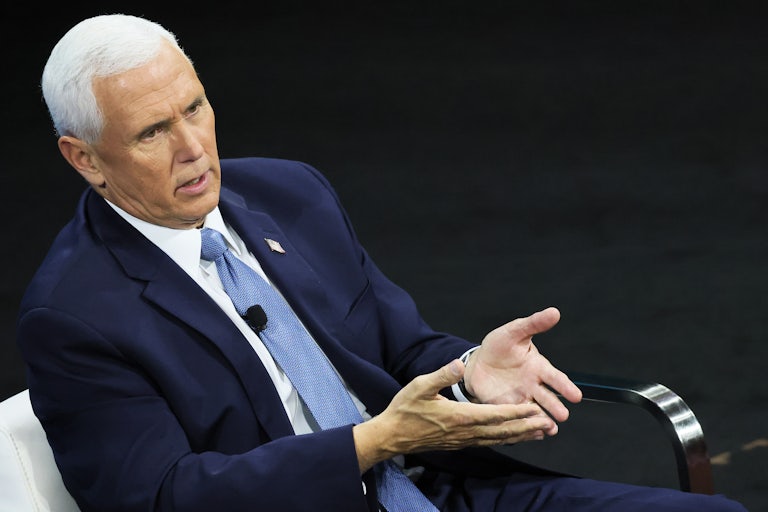
Former Vice President Mike Pence said Wednesday that he plans to resist the subpoena issued to him by the special counsel investigating Donald Trump’s role in January 6.

It was no surprise that Jack Smith issued the subpoena last week: He has been slowly closing in on Trump and the former president’s inner circle, and Pence is a key witness to both the events of January 6, 2021, and Trump’s state leading up to them.

But Pence is refusing to play ball. “I’m going to fight the Biden DOJ’s subpoena … because it’s unconstitutional and because it’s unprecedented, and the DOJ knows that,” Pence told reporters after an event in Minnesota. “The Constitution of the United States provides the executive branch cannot summon officials in the legislative branch into a court.”

Pence is arguing that he is protected by legislative privilege under his former role as president of the Senate. He believes that position shields him from Justice Department investigations under the Constitution’s “speech or debate” clause.

That clause’s purpose is to protect members of Congress from having things they say during legislative activities be used against them in lawsuits.

“For me, this is about the Constitution. If we lose the Constitution, we won’t just be losing elections. We’re going to lose our country,” Pence said.

He likened his current stance to when he refused to overturn the results of the 2020 election despite intense pressure from Trump.

Pence’s refusal to cooperate is infuriating but unsurprising. Despite the fact that the rioters wanted to hang him—which White House aides have said Trump felt was deserved—the former vice president has repeatedly refused to testify in January 6 investigations.

The reason is simple: Pence is reportedly considering running for president in 2024. If he does, he will need all the support he can get, including from Trump’s base. If Pence testifies, he’ll have to denounce Trump, alienating his former boss’s supporters in the process.

But his argument against testifying doesn’t hold that much water. As part of an effort to remain in the public consciousness, he has released a book about his time at the White House. The memoir includes many details he would be asked to testify on.

New York Democrats Overwhelmingly Block Kathy Hochul’s Pick for Top Judge

Hochul is doing everything she can to push through Hector LaSalle, and it’s not working.

Virginia Governor Glenn Youngkin speaks outside with a mic in his hand
Michael M. Santiago/Getty Images

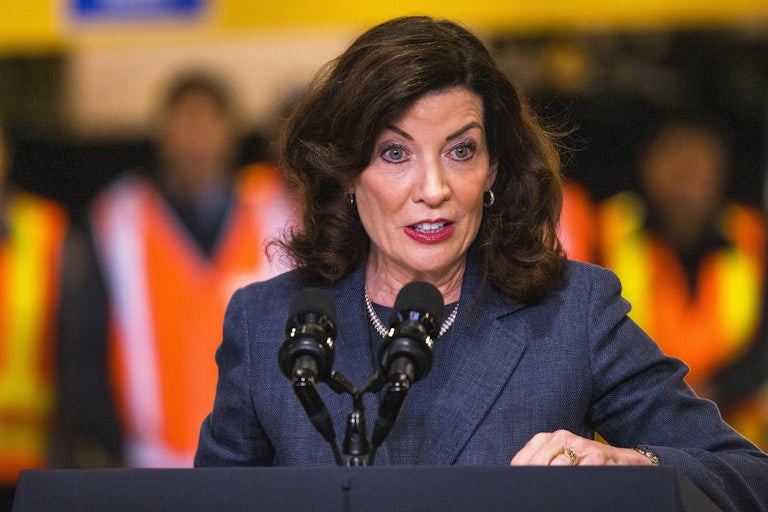
New York Governor Kathy Hochul has made history, after her nominee for the state’s highest court was rejected by the entire state legislature.

Last month, Hochul’s controversial nominee, Judge Hector LaSalle, was rejected by the Senate Judiciary Committee. And on Wednesday, the Senate held a full floor vote and again rejected LaSalle, this time by a vote of 39–20.

Hochul released a statement Wednesday afternoon finally relenting, though perhaps not fully. “This vote is an important victory for the Constitution,” she said. “But it was not a vote on the merits of Justice LaSalle.” Hochul said she will now proceed to make a new nomination.

New York Senate Democrats initially voted against LaSalle due to concerns from the entire Democratic constituency over his judicial record on labor, abortion, and criminal justice. Rather than heeding their earlier warnings, Hochul instead promised to do “everything” in her power to push her nominee onto the state’s Court of Appeals.

The drama began in December, when, just weeks after beating a Republican during a midterm election in New York by only five points, Hochul chose to nominate LaSalle, whose record was criticized by liberals, progressives, workers, and abortion voters as being antagonistic to supposed Democratic values. These various constituent groups maintained pressure on legislators, and by Wednesday’s vote, at least 25 of the 63 state senators had publicly expressed opposition to LaSalle’s nomination.

Instead of responding to the criticism and nominating someone else from her list of seven potential picks, Hochul spent much of her political capital, and then some, to impose her will and force through LaSalle’s nomination anyway.

In early January, Hochul allegedly revoked Ironworkers Vice President James Mahoney’s invitation to the State of the State address, after the prominent labor representative criticized Hochul’s pick. It felt like being put “on the menu,” Mahoney said, particularly after he and other labor organizers worked so hard to elect Hochul in the first place.

Days later, newly anointed House Minority Leader Hakeem Jeffries went out of his way to appear alongside Hochul at a Bronx rally to enthusiastically endorse LaSalle. This was particularly striking given that Jeffries is House minority leader, and not House speaker, in no small part thanks to the Cuomo-crafted conservative majority on the state’s top court, which drew unfavorable district maps.

Her audacity never to be discounted, Hochul then appeared at two New York City churches on Martin Luther King Jr. Day to rally support for her nomination. “My household knew the story of Dr. King,” Hochul preached to the unsuspecting audience. “When he was gunned down, assassinated, my family sat there and held hands and wept. How could this be? How could this man of God who taught us about nonviolence and social justice and change, and not judging people by the color of their skin, or one or two cases out of 5,000 cases decided,” she concluded, tying the assassination of one of America’s most historic civil rights leaders to her unpopular court nominee.

Nevertheless, in mid-January, the state’s Senate Judiciary Committee voted to prevent Judge Hector LaSalle from advancing to a Senate-wide vote. Buttressed by Democratic voters across the ideological spectrum, 10 of the committee’s 19 Democrats voted against LaSalle, sinking his nomination with a final vote count of 2–10–7. (Two members voted unequivocally for him; seven voted to advance him without recommendation.)

Even then, Hochul wasn’t satisfied. She volleyed threats to take legal action against the Committee for tanking the nomination, on the grounds of the rejection being unconstitutional. She argued that such a nomination necessitated a Senate-wide vote; but New York’s Constitution only dictates that a governor must make judicial appointments with the “advice and consent of the Senate.”

Last week, Republican State Senator Anthony Palumbo filed a lawsuit against the Senate, Democratic Majority Leader Andrea Stewart-Cousins, and the Democrats in the judiciary committee who voted against LaSalle. The lawsuit was based on Hochul’s own arguments about constitutionality, but its legal case appears flimsy, homing in on some language while ignoring others. For instance, the lawsuit’s proponents seemed less interested in the part of the state constitution that reads, “Each house shall determine the rules of its own proceedings.”

But Wednesday’s result likely upends whatever ruling was to come from the case. By Hochul’s own wishes, Democrats gave her her statewide vote. And today, by Hochul’s own actions, she was embarrassingly rebuked once again.

This post has been updated.

Virginia Gov. Glenn Youngkin Helps Defeat Bill That Would Prevent Cops From Accessing Period App Data

The Republican governor has also promised to sign any anti-abortion bills that reach his desk.

Virginia Governor Glenn Youngkin speaks with a mic in his hand
Alex Wong/Getty Images

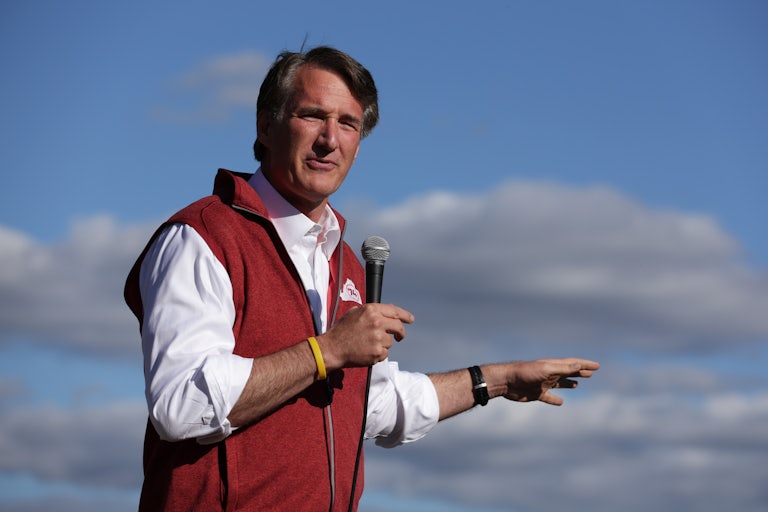
Virginia’s Republican Governor Glenn Youngkin poured cold water on a bill that would have prevented law enforcement from accessing data stored on period-tracking apps.

The bill, which comes amid increasing attacks on abortion nationwide, had already passed the state Senate with broad bipartisan support. Only nine of the chamber’s 18 Republicans voted against it, while the other half sided with the Democratic majority. But it failed in the House of Delegates Monday after Youngkin’s administration expressed opposition to it.

“Currently, any health information or app information is available via search warrant,” said Virginia’s Deputy Secretary of Public Safety and Homeland Security Maggie Cleary, speaking on Youngkin’s behalf. “We believe that should continue to be the case.”

She warned legislators the bill would be the very first to limit what state courts can deem relevant enough to criminal cases that it merits a search warrant.

The bill’s sponsor, Democratic Senator Barbara Favola, argued that period data should be considered a unique case because “there’s very little information that is as personal and private as your menstrual data.” But the bill still failed 5–3 along party lines.

“It is exceptionally disquieting to see Governor Youngkin oppose a bill that would protect women from having their private health data weaponized against them in a court of law,” Democratic Party of Virginia press secretary Liam Watson said in a statement.

Tarina D. Keene, the executive director of the abortion rights group, REPRO Rising Virginia, told The Washington Post that Youngkin’s “opposition to this commonsense privacy protection measure shows his real intentions—to ban abortion and criminalize patients and medical providers.”

Since the fall of Roe v. Wade, many people have worried that data collected from hugely popular period-tracking apps could be weaponized as a means to find and prosecute those who get abortions.

Millions of people use such apps, which are not bound by HIPAA, the federal health privacy law. This means that the app companies are required to hand over information to law enforcement if asked. Abortion rights groups have warned the information could be used against both people who seek abortions and the medical workers who carry out the procedure.

Abortion in Virginia is currently legal up to 26 weeks of pregnancy. State law allows prosecutors to charge doctors who violate the restrictions, but not the patients. Youngkin’s office has said he will not sign legislation that “imprisons women” for getting the procedure, but he has also pledged to sign any abortion bans that reach his desk.

He backed a 15-week abortion ban after Roe was overturned, and in his proposed budget unveiled in December, he proposed setting aside $50,000 to establish that limit. The ban failed in the Senate in late January.

Youngkin’s opposition to privacy for menstrual history comes just days after the Florida High School Athletics Association decided not to require student athletes to provide their schools with detailed information about their periods.

A board panel had recommended the requirement in January, which caused such a massive outcry over privacy violations that the board called an emergency meeting over the rule. On the national level, a group of Democratic representatives also introduced a bill that would block schools that receive federal funding from requiring students to provide their menstrual data. The bill is unlikely to pass the House, which is controlled by Republicans, who have made it clear they are cracking down on all abortion-related rights.