Breaking News
Breaking News
from Washington and beyond

Paul Ryan Says He’ll Skip the 2024 RNC if Trump Is the Nominee: “We’re Going to Lose With Him”

The former House speaker endorsed Donald Trump in 2016.

Paul Ryan
Mateusz Wlodarczyk/NurPhoto/Getty Images

Former House Speaker Paul Ryan said he won’t attend the Republican National Convention if Donald Trump is the presidential nominee, a lackluster and pretty on-brand rebuke.

Speaking to a local Milwaukee news station Sunday, Ryan said that even though the 2024 convention will be held in his home state of Wisconsin, his attendance “depends on who the nominee is.”

“I’ll be here if it’s somebody not named Trump,” Ryan said. “I’m not interested in participating” if Trump does become the GOP presidential nominee.

Ryan argued Trump has been bad for the party, noting the former president “cost us the House in ’18, he lost the White House in ’20, he cost us the Senate in ’20, he cost us the Senate again in 2022, and he cost us probably a good dozen House seats in 2022.”

It’s not entirely clear, though, what Ryan thinks his tepid protest will accomplish. It’s been a while since he had any real political influence. He was Mitt Romney’s running mate in 2012 and then served as House speaker for four years, leaving behind a chaotic legacy.

Ryan repeatedly criticized Trump’s actions during the 2016 presidential campaign but always stopped just short of actually taking a stand against him. He ultimately endorsed Trump in June that year.

In the two years he served as speaker under Trump, Ryan took advantage of Republican control of the White House and Congress to help push through his own agenda. Since leaving office, having gotten what he wanted, he has become more outspoken against Trump, previously calling him a “proven loser.”

But Ryan has stayed true to his lukewarm brand of criticism. As a result of his unwillingness to stand up to Trump, Ryan briefly landed on Wikipedia’s list of invertebrates in 2017.

Trump hit back at Ryan on Truth Social, also taking the opportunity to plug his lie that he won the 2020 election. “Paul Ryan is a loser, Mitt Romney could have won without him. I won twice, did much better the second time, and was 233 Wins out of 253 Races in the Midterms. Paul Ryan is destroying Fox, and couldn’t get elected dogcatcher in the Republican Party!” he said.
Ex-Senator Jim Inhofe Retired Due to Long Covid, Says at Least Five Other Congress Members Also Have It

The Oklahoma Republican called out his colleagues.

Stefani Reynolds/Pool/Getty Images
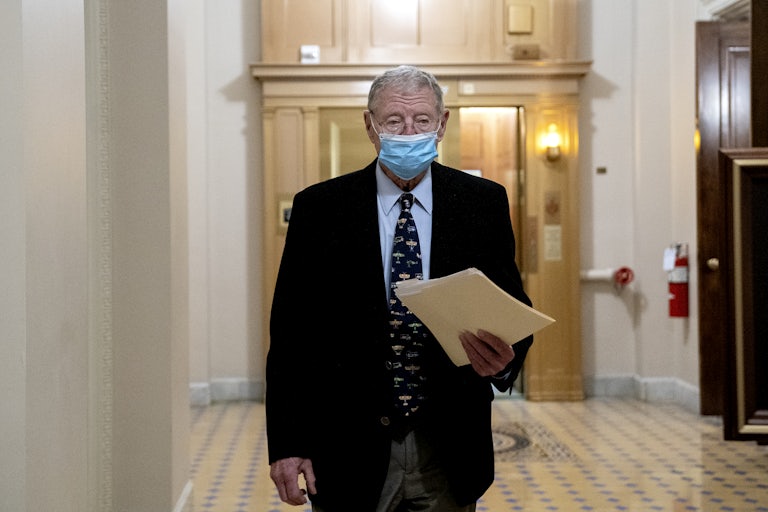
Senator Jim Inhofe

Former Senator Jim Inhofe revealed that he suffers from long-term effects of Covid-19, which played a part in his decision to retire from Congress, and at least five other members of Congress suffer from the same thing.

The Oklahoma Republican announced last February he planned to retire after almost 40 years on Capitol Hill. During the same press conference, his chief of staff announced that Inhofe had contracted a “very mild” case of Covid-19. But clearly, the effects of the virus have been much longer-lasting. And he’s not the only one.

“Five or six others have (long Covid), but I’m the only one who admits it,” Inhofe told Tulsa World in a recent interview.

He did not say what symptoms of long Covid he suffers from, nor which other members of Congress are struggling with long Covid. But Democratic Senator Tim Kaine has been open about his mild long Covid symptoms.

Inhofe struck a highly contradictory tone during the start of the coronavirus pandemic. He warned people to take the virus seriously, telling Tulsa World in a March 2020 interview, “You know I’d be the first to say we’re overreacting because that’s kind of how I am, but we’re not. By people not believing, by not taking precautions, they’re making it more likely to spread.”

In the same interview, however, he said he had tried to annoy a reporter by saying he wasn’t doing anything to protect himself against Covid and then trying to shake hands.

Inhofe also voted against several key Covid relief bills, including the Families First Coronavirus Response Act, which required employers to give employees paid sick leave or expanded medical and family leave for Covid-related reasons. That bill had enormous bipartisan support, with 90 senators voting for it.

Inhofe also voted against the American Rescue Plan, which was aimed at providing economic relief due to the crisis caused by the pandemic. The bill included funding for the national vaccination program, the stimulus checks, and the expanded unemployment benefits.

Republicans Suddenly Pretend to Care About Infrastructure, Just to Criticize U.S. Aid to Ukraine

Well, that’s a new one.

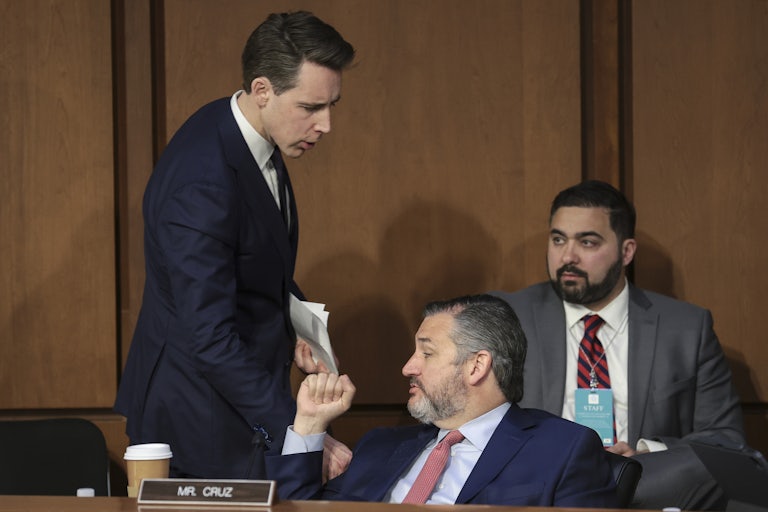
Josh Hawley bends down to talk to Ted Cruz, seated, who holds up a clenched fist
Win McNamee/Getty Images
Senators Josh Hawley and Ted Cruz

Republicans who have spent years blocking critical infrastructure spending suddenly seem incensed at the idea that we are not spending money on critical infrastructure.

Friday marked one year since Russia’s invasion of Ukraine, and throughout the week, Republicans increasingly and in larger numbers criticized the Biden administration’s support of the attacked nation. And they’ve been using the disastrous Norfolk Southern train derailment in East Palestine, Ohio, as fodder for their complaints.

Regardless of one’s specific views on sustained military support for Ukraine, the argument is rich coming from conservatives, who have fought tooth and nail to water down massive infrastructure investments over the past few years, especially in Biden’s Build Back Better effort.

Tucker Carlson, for example, has dedicated countless hours on his program to bullying Republicans for supporting infrastructure spending, only to suddenly change tune when he could then blame it all on Ukraine.

The Infrastructure Investment and Jobs Act was first introduced by the Biden administration as a $2.3 trillion appendage of the larger investment effort. After conservative stonewalling, the bill was cut to $1.2 trillion in what was then called the Bipartisan Infrastructure Law. About $14 billion of rail modernization dollars were cut out in the watered-down framework. Such is the cost of “bipartisan” collaboration with intransigent Republicans, it seems. And this was just one of many losses incurred after conservatives—including Senators Joe Manchin and Kyrsten Sinema—hamstrung Democratic efforts to deliver on the infrastructure-building agenda they were elected to carry out.

Two years ago, Senator Ted Cruz bragged about standing strong alongside Senators Ron Johnson and Mike Lee against any Republicans expressing a willingness to work with Democrats.

And now Cruz, who cosplayed as an ally to rail workers asking for more industry regulation, is in fact holding his tune for deregulation:

And while celebrating more deregulation, Cruz also spent his week podcasting to complain about Biden visiting Ukraine.

Meanwhile, Johnson is busy fundraising off the East Palestine derailment, complaining that “the media is barely covering this.” Beyond taking money from Norfolk Southern and fighting against infrastructure spending alongside Cruz, one of the only rail-related bills Johnson has signed off on was one backed by the Association of American Railroads. It sought to delay the industry-wide implementation of a monitoring system to help prevent train collisions and derailments. Norfolk Southern is among the companies represented by the association.

Senator Josh Hawley is also now pitting spending on Ukraine and East Palestine against each other, but years ago, he complained about the proposed infrastructure bill. He took specific issue with the bill’s environmental investments. (Conservatives now feign concern for the kinds of environmental issues in East Palestine that plague communities all across the country, ones that would in fact have been addressed by Green New Deal–esque investment).

It is reasonable to question how long the United States may stay involved in Ukraine—or any affairs elsewhere, given our track record. But it’s unserious for conservatives who have already dedicated much of their careers to fighting against government investment to now posture as eager proponents of mass infrastructure projects. But, hey, if it’s sincere, be our guest: We’ll be waiting for the legislation!

Georgia Republicans Want to Charge People Who Get Abortions With Homicide

Meanwhile, the majority of Georgians say they want to keep the procedure legal.

Sign reads: "The Land of the free? Choice = freedom"
Megan Varner/Getty Images
A protester holds a sign while marching and chanting through Downtown Atlanta on July 23.

Georgia Republican lawmakers have introduced a bill that would classify abortion as a homicide, despite their own constituents’ widespread opposition to banning the procedure.

The bill, introduced Thursday, would classify a human as an “unborn child at every stage of development from fertilization until birth.” As a result, terminating a pregnancy could be considered and prosecuted as a homicide. Writer Jessica Valenti noted that since the bill says life begins at fertilization, people who use IUDs or emergency contraception—both of which prevent fertilized eggs from implanting—could be charged with murder.

The legislation makes exceptions for medical procedures carried out to save the life of the pregnant person, done because there were no viable other options to save the fetus, or that resulted in an accidental miscarriage. People who got abortions would be found not guilty of homicide if they could prove they were coerced or misled into getting the procedure.

If it passes, this bill would both fly in the face of what people actually want when it comes to abortion legislation and be incredibly dangerous for people’s health and well-being.

The majority of Americans, 64 percent to be exact, support legalizing abortion, which made the Supreme Court’s overturning Roe v. Wade all the more bitter a pill to swallow. A new study by the Public Religion Research Institute looked at levels of support at the state level and found that 57 percent of Georgians think abortion should be legal in all or most cases. Currently, abortion in Georgia is banned after six weeks, before most people even know they are pregnant, with exceptions for rape, incest, or to save the pregnant person’s life.

Clamping down on abortions would also cause far more harm than good. A study published in November by researchers at the University of Colorado Boulder found that if Georgia bans abortion, maternal mortality will increase 29 percent. Georgia already has the second-highest rate of maternal mortality in the United States, which has the highest rate of maternal mortality among developed nations, according to the World Population Review.

Classifying abortion as a homicide would significantly deter people from seeking the procedure, even if they need it, and could put their health at risk.

Unfortunately, Georgia is not alone in seeking to criminalize people who get abortions. Republican lawmakers in Kentucky, where 50 percent of residents support legalizing abortion, and Alabama, where 55 percent of residents support abortion, have also debated bills that would classify abortion as a homicide in the past week. Representatives in South Carolina, where 50 percent of residents back abortion access, introduced a bill Wednesday that would make abortion punishable by the death penalty.

Not only do these bills go against the will of the people, some lawmakers are actively trying to circumvent what their constituents want. Kentucky was one of five states that voted to protect abortion access during the midterm elections. In Kansas, lawmakers are trying to let cities and counties ban abortion after residents overwhelmingly voted to keep abortion protections in the state constitution.

Florida Republicans’ New Bill May Be the Biggest Attack on Academic Freedom Yet

The bill, backed by Governor Ron DeSantis, goes after degrees, tenured professors, and more.

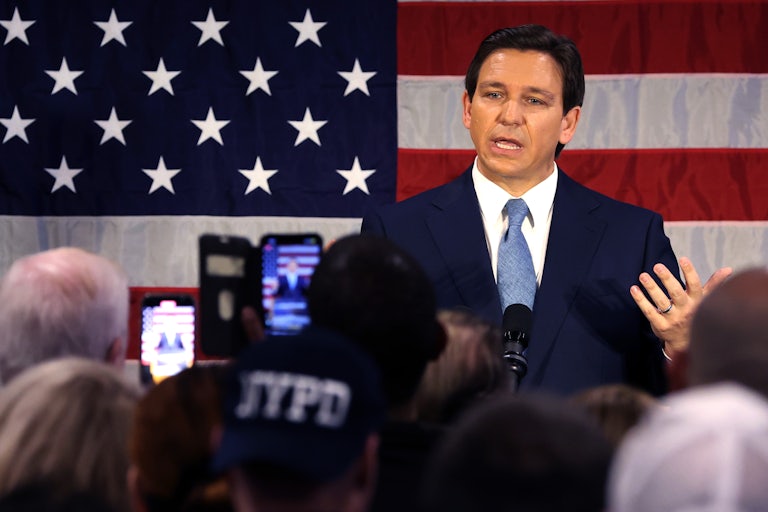
Ron DeSantis
Spencer Platt/Getty Images

After Ron DeSantis’s months of attacks on colleges, schools, teachers, librarians, and students, the Florida governor is now pushing a sweeping legislation package that further threatens academic freedom at Florida universities.

House Bill 999 presents radical concentrations of power, taking liberties away from students and teachers and instead subjecting them to constant surveillance and paranoia for simply trying to embrace a fulsome education.

The bill calls for the removal of degrees in gender studies and critical race theory (or “any derivative major or minor of these belief systems,” perhaps left intentionally ambiguous) and bars anything else that promotes diversity, equity, and inclusion. The bill also prohibits universities from promoting, supporting, or maintaining any program or campus activities that “espouse diversity, equity, and inclusion or Critical Race Theory rhetoric.”

The bill additionally directs university boards of trustees to be responsible for faculty hiring, and reads that a faculty member’s tenure could be reviewed “at any time.” In a vacuum, that may not seem inherently bad; given the chiling nature of the rest of the bill (and the broader Florida academic context), such a note suggests a regime eager to threaten tenure loss for those who step out of bounds.

If that all wasn’t enough, the bill also says that general education courses may not “suppress or distort significant historical events or include a curriculum that teaches identity politics, such as Critical Race Theory, or defines American history as contrary to the creation of a new nation based on universal principles stated in the Declaration of Independence.” And they ought to “promote the philosophical underpinnings of Western civilization.”

These general education courses further must “promote the values necessary to preserve the constitutional republic through traditional, historically accurate, and high-quality coursework,” and cannot be “based on unproven, theoretical, or exploratory content.”

The standards are largely to be overseen by the state Board of Education and Board of Governors—bodies whose members are appointed by the governor. And so determinations of what does and does not constitute “diversity, equity, and inclusion,” or “values necessary to preserve the constitutional republic,” or even “accurate” are all ill-defined, amorphous, and ambiguous enough for Governor DeSantis’s authoritarian regime to carry out its desire to carve away any chance for Florida students to maintain a holistic and open-minded education.

House Bill 999 is indeed a focused continuation of DeSantis’s assault against academic freedom. But it is also a broader test: about how much power an aspirational fascist state executive can openly accumulate in America.