Breaking News
Breaking News
from Washington and beyond

Every Democrat Who Voted With Republicans to Block a Rule on Sustainable Investing

Environmental, social, and corporate governance, or ESG, investing is Republicans’ new favorite target in the war on “wokeness.” And a few Democrats are helping them.

Senators Joe Manchin and John Tester speak outside. The Capitol is in the background.
Stefani Reynolds/Bloomberg/Getty Images
Senators Joe Manchin and John Tester

Two Senate Democrats sided with Republicans Wednesday to pass a bill blocking the Labor Department from implementing a rule that allows retirement plans to consider environmental, social, and corporate governance, or more sustainable, investing practices.

The bill, the latest salvo in Republicans’ manufactured culture war, passed 50–46. It passed the House on Tuesday and now goes to Joe Biden, who has said he will use his veto powers for the first time in his presidency to block the measure.

The Democrats who helped Republicans get the bill over the finishing line in both chambers of Congress are:

  • Senator Jon Tester of Montana
  • Senator Joe Manchin of West Virginia
  • Representative Jared Golden of Maine

Environmental, social, and corporate governance, or ESG, is a framework that helps investors understand how an organization—in this case, retirement savings plan managers—manages risks and opportunities regarding sustainability. Issues of sustainability include environmental protection, impact on society, and aligning corporate leadership goals with stakeholder ones.

The Labor Department rule makes it easier for retirement plan managers to consider ESG factors such as climate change when making investments or voting on behalf of shareholders. It does not actually require the plans to include these considerations, making it clear this bill is just another Republican attempt to fearmonger over something that’s really not bad.

ESG investing also tends to have positive long-term effects, including higher sales to customers, higher employee productivity, and higher company valuation, as well as the impact on environmental and social issues.

Both Manchin and Tester, who are up for reelection in 2024, said they were voting to block the Labor Department rule because they thought retirement funds should focus solely on ensuring returns on investments—even though there is a link between positive performance for ESG investments and financial returns.

House Democrats, meanwhile, have introduced a competing bill called the Freedom to Invest in a Sustainable Future Act that would codify retirement plan managers’ right to consider ESG factors when making decisions. It is unlikely to get the support it needs to pass the Republican-controlled House.
Kevin McCarthy’s Pathetic Defense for Giving January 6 Footage to Tucker Carlson

The House speaker keeps coming up with new reasons why the Fox News host should get access.

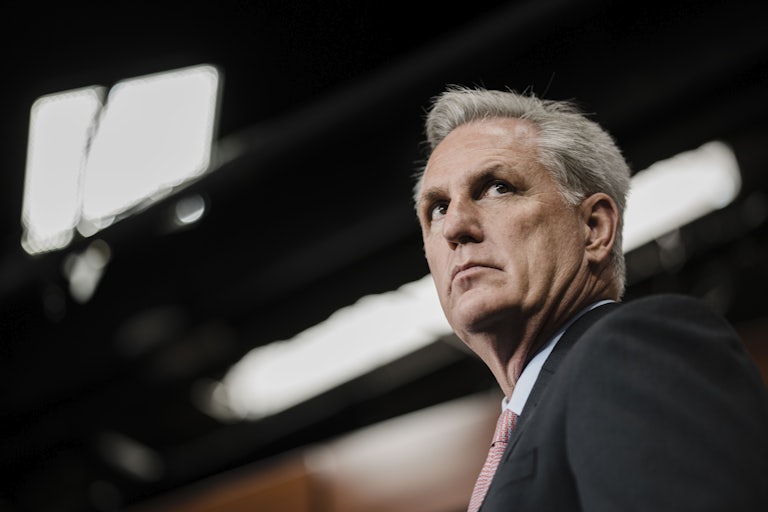
A close-up of House Minority Leader Kevin McCarthy, glancing to the side.
Kent Nishimura/Los Angeles Times/Getty Images

House Speaker Kevin McCarthy has accused the news media of being “jealous” that Fox News host Tucker Carlson got there first to ask for access to the security footage from the January 6 attack.

McCarthy has come under fire for giving Carlson exclusive access to 41,000 hours of security footage from the 24 hours surrounding the insurrection. Democrats are worried that Carlson, who has repeatedly downplayed the severity of the attack and claimed it was a false-flag operation, will use the videos to spread more disinformation about January 6.

“It almost seems like the press is jealous,” McCarthy told The Washington Post. “And that’s interesting because every person in the press works off exclusives on certain things.”

“People like exclusives, and Tucker is someone that’s been asking for it,” said McCarthy, describing Carlson’s coverage as “opinion,” not news. “So I let him come in and see it, but everyone’s going to get it.”

Putting aside the fact that McCarthy’s main argument is that Carlson called first dibs, giving Fox News access in any case is dangerous. As Representative Alexandria Ocasio-Cortez pointed out, “They are experts in manipulating media and cutting context, so it’s absolutely true that they may take some of that tape and manipulate it in really disturbing ways that could incite violence.”

Carlson and his colleagues are fully aware that they are spreading conspiracy theories and false information about the 2020 election and January 6. Fox News owner Rupert Murdoch admitted he knew his organization was spreading lies about the 2020 election results in a deposition for a lawsuit filed by Dominion Voting Systems made public Monday. A week earlier, Dominion also released a trove of messages and depositions from anchors, including Carlson, in which they admitted they knew the election conspiracies were false but continued to share them anyway.

Releasing the footage could provide key information to anyone who might want to try to redo January 6. The videos could reveal strategic locations in the Capitol, such as safe rooms and cameras, as well as give people a better sense of the building’s layout, making it harder for lawmakers to run and hide.

McCarthy has managed to one-up himself, though, announcing Tuesday that the January 6 footage would also be made available to the defense lawyers for people charged in connection with the riot.

The California Republican insisted that the footage was already made available to the defendants under former House Speaker Nancy Pelosi. But a Pelosi spokesperson said she never authorized access to the footage “because Speaker Pelosi did not have that authority and believes that it appropriately belongs to security officials.”

McCarthy also accused the Democrats of hypocrisy because the House January 6 investigative committee had shown footage from the day, and Pelosi’s daughter had posted a video online of lawmakers in a secure military base after evacuating the Capitol.

Alexandra Pelosi’s video did not show the escape route from the Capitol or any information about their location that was not already publicly known. A spokesman for the January 6 committee had already said in a statement that any footage shown during the hearings “was treated with great sensitivity.”

“Access was limited to members and a small handful of investigators and senior staff, and the public use of any footage was coordinated in advance with Capitol Police. It’s hard to overstate the potential security risks if this material were used irresponsibly,” the spokesman said.

Bernie Sanders Moves to Subpoena Starbucks CEO Howard Schultz for Union-Busting Allegations

Schultz has previously declined invitations to appear before the Senate about the allegations.

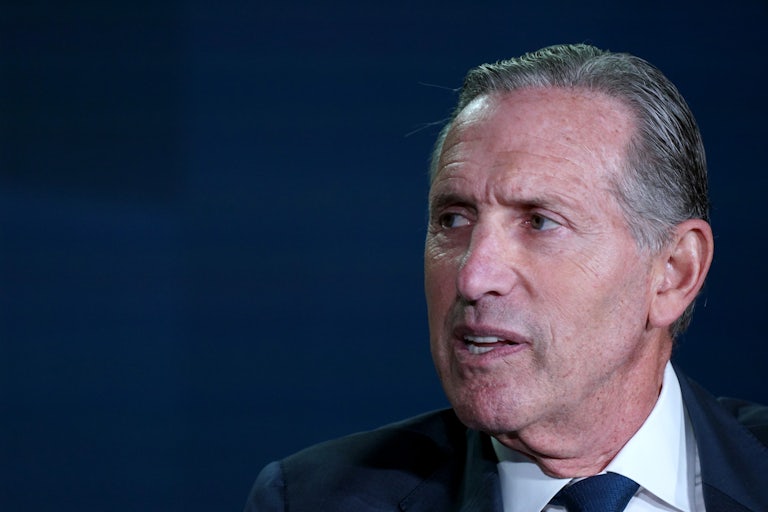
Howard Schultz close-up
Leigh Vogel/Getty Images for The New York Times
Howard Schultz

Senator Bernie Sanders is continuing to use his newfound committee influence to hold corporate leaders’ feet to the fire. Now he’s calling to subpoena Starbucks CEO Howard Schultz, on allegations of the company’s union-busting.

Sanders announced Wednesday that the Senate’s Health, Education, Labor and Pensions, or HELP, Committee will vote on March 8 as to whether it will issue a subpoena to the Starbucks executive, who previously declined a voluntary invitation to appear in front of the committee.

Starbucks cited Schultz’s scheduled March step-down as reason to offer a company chief public affairs officer to appear instead. The HELP committee was not interested in the alternative and subsequently is looking to forcibly subpoena Schultz.

“The National Labor Relations Board (NLRB) has filed over 75 complaints against Starbucks for violating federal labor law and there have been over 500 unfair labor practice charges lodged against his company,” Sanders said in a statement. “Unfortunately, Mr. Schultz has given us no choice, but to subpoena him. A multi-billion dollar corporation like Starbucks cannot continue to break federal labor law with impunity. The time has come to hold Starbucks and Mr. Schultz accountable.”

The announcement comes the same day that over 70 white-collar Starbucks employees and even managers released a letter in protest of the company’s return-to-office policies and its alleged union-busting activity. “We call on Starbucks to commit to a policy of neutrality and respect federal labor laws by agreeing to follow Fair Election Principles, and allow store partners, whether pro- or anti-union, to decide for themselves, free from fear, coercion, and intimidation.”

As of this writing, at least 412 Starbucks stores nationwide have attempted a unionization effort; 281 have successfully unionized, and another 37 elections are ongoing. Given allegations of union-busting activity coming from both store and corporate workers, as well as Congress itself, the 57 failed and 33 withdrawn bids may generate further scrutiny, when compared to the overwhelming number of successful efforts.

Senators Introduce Bipartisan Bill to Make Railroads Safer After East Palestine Train Derailment

A new bill would go a long way in trying to prevent another disaster like the one in Ohio.

The train derailment in East Palestine, Ohio, on February 14

Don’t miss it—Congress might actually be doing something to hold railroads accountable and make workers and the broader public safer.

On Wednesday, a group of bipartisan senators (Sherrod Brown, J.D. Vance, Bob Casey, Marco Rubio, John Fetterman, and Josh Hawley) introduced the “Railway Safety Act of 2023” to address some of the concerns about rail safety that resurfaced after the disastrous Norfolk Southern train derailment in East Palestine, Ohio.

The bill calls for stronger safety standards for all trains carrying hazardous materials and also expands those standards to trains not currently subject to high-hazard flammable train, or HHFT, regulations (like the train in East Palestine).

It also mandates a freight train be operated by at least two-person crews, which rail workers have been demanding for some time, and increases penalties for companies that violate any rail safety standards.

Enforcement for many of the bill’s provisions will be key, however, says Railroad Workers United Co-Chair Ross Grooters. “It appears to be a step in the right direction, but we need to pay attention to the details,” Grooters told TNR. “Often railroads are reactionary. They tend to do the minimum and create unintended consequences within the law. Ensuring we have strong enforcement and no loopholes is key.”

The Senate legislation, similar to a House bill introduced Tuesday, directs rail carriers to proactively communicate with local, state, and tribal emergency response commissions when hazardous materials are being transported.

The bill also calls on the transportation secretary to carry out numerous provisions and enact further regulation. So, to Grooters’s point, the execution will still depend on agency will.

Under the legislation, the transportation secretary is responsible for creating new safety standard procedures on an array of items, including how big trains can be and how fast they can go, how frequently trains should be inspected, and to direct audits of the inspection programs themselves.

The bill also directs the transportation secretary to issue new regulations on the equipment used to monitor trains carrying hazardous materials. This measure comes as the National Transportation Safety Board deemed that an overheated wheel bearing was part of what led to the Norfolk Southern train derailing in East Palestine. The bill mandates that trains carrying hazardous materials be scanned by hotbox detectors every 10 miles and that the detectors be equipped to alert rail operators effectively.

The legislation further calls to collect funds from rail operators in order to carry out additional emergency response training. And the bill appropriates $22 million for research and development into detectors and $5 million for developing safer tank cars.

There are some differences between the Senate bill and the separate rail safety bill introduced in the House, including on what gets classified as a high-hazard flammable train.

Of note is that the bill also did not include any specific guidance or directive surrounding the revival of the Obama-era rule to mandate updated braking systems at least for trains carrying hazardous materials.

Nevertheless, it is unmistakably a great step forward for Congress to be pushing the slate of measures, particularly in a bipartisan manner. The words are now officially on paper, and anyone looking to oppose or water down the bill should be put on notice—especially since there’s still much more to be done.

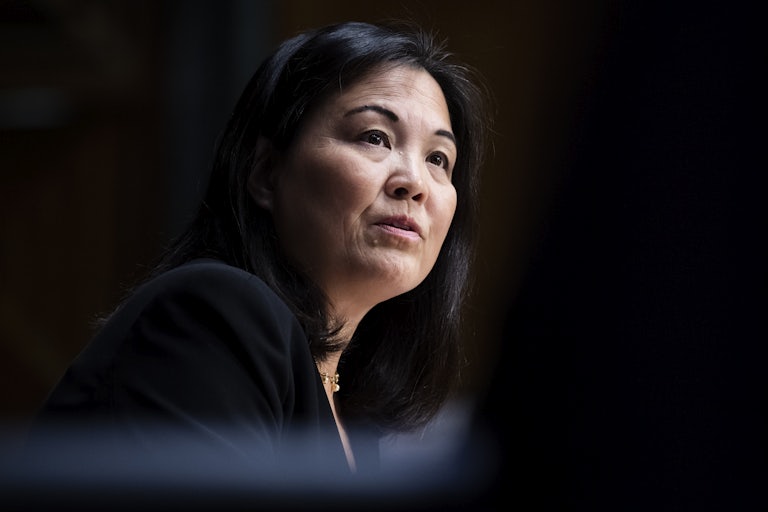
Who is Julie Su, Biden’s New Pick for Labor Secretary?

President Joe Biden has officially nominated Julie Su to serve as labor secretary. Here’s what her record looks like.

Tom Williams/CQ-Roll Call/Getty Images
Julie Su

Julie Su is on track to become the first Asian American person to serve as a Cabinet secretary under the current administration.

President Joe Biden announced Tuesday that he was nominating Su, currently the deputy labor secretary, to head the entire Department of Labor.

“Julie knows in her bones … that people who get up every morning and go to work and bust their necks just to make an honest living deserve something, someone to fight at their side to give them an even shot,” Biden said in an official announcement ceremony Wednesday. “Julie has spent her life fighting for that vision.”

He also highlighted Su’s upbringing as the daughter of Chinese immigrants in Wisconsin. “Julie is the American dream,” Biden said.

Su, 54, first made a name for herself almost three decades ago as a young lawyer in California. When she was just 26, she led a legal team representing a group of more than 70 enslaved Thai garment workers in El Monte, near Los Angeles. The workers were undocumented and forced to live and work in an apartment complex that functioned as a sweatshop in order to “earn” their freedom. Many had been trapped there for seven years before the operation was discovered in a police raid.

Su and her team sued the workers’ captors, as well as the manufacturers and retailers of the clothes produced in the sweatshop. The case, which was one of the worst instances of labor exploitation and human rights violation in the United States, helped spur a change in California’s legislation to increase worker protections.

Since then, Su has served as the head of California’s Division of Labor Standards Enforcement and as the state’s labor secretary. In February 2021, Biden nominated her as deputy secretary for the Labor Department. She was seen as a younger, more progressive voice, and her nomination was welcomed by the Congressional Asian Pacific American Caucus, which has called on Biden from the start to nominate more Asian Americans and Pacific Islanders to his Cabinet.

Su’s nomination for deputy passed the Senate 50–47 along party lines. Although Democrats control the Senate, Su may be up for a bit of a fight. Many party members, such as Nancy Pelosi, have backed former New York Representative Sean Patrick Maloney—the man who cost his party several key seats during the 2022 midterms—for labor secretary.

Su could also be unpopular for her role in helping avert a national rail strike in December, which culminated with Biden signing a bill that imposed a contract with no paid sick leave on 115,000 rail workers, the majority of whom had opposed the contract.

Progressive Senators Bernie Sanders and Elizabeth Warren have hailed Su’s nomination, with Warren calling her “terrific.” Sanders, who is chair of the Health, Education, Labor and Pensions Committee, said he thought Su was an “excellent” choice and looked forward to working with her to “protect workers’ rights and build the trade union movement.”