Breaking News
Breaking News
from Washington and beyond

Mitch McConnell Ruthlessly Drowned Out With Chants of “Retire!”

I think Mitch McConnell’s constituents want him to retire.

Kevin Dietsch/Getty Images

Spectators drowned out Mitch McConnell’s attempts to give a speech over the weekend with boos and demands he retire, a week after the Senate minority leader froze during a press conference.

McConnell appeared at a church picnic in his home state of Kentucky on Saturday. But when he got up to give a speech, he got probably the exact opposite reaction he was expecting.

Picnic attendees booed him and chanted, “Retire!” They also called out, “Shame on you, “Ditch Mitch,” and “Lost the Senate!” McConnell futilely attempted to keep speaking, but the chants were far too loud for him to be heard.

The heckling comes about a week after McConnell froze during a news conference and appeared unable to continue speaking. He was escorted away from the cameras, and when he returned later, McConnell declined to comment on what happened or whether it was related to the fall he suffered in March, which resulted in a concussion and his weeks-long absence from the Senate.

In addition to his concussion, McConnell reportedly fell while at the airport just three weeks ago, and he has been using a wheelchair to get around crowded areas. His physical condition isn’t actually that surprising: At 81, he’s the longest-serving Senate party leader, and he’s a member of the second-oldest Senate in history.

His fellow Republicans are also starting to make noise about his stepping down. Another Republican senator told NBC anonymously last week that McConnell is “definitely slower with his gait” and that he declines to discuss his health in private. Another Republican senator, again speaking anonymously to NBC, said that McConnell doesn’t speak nearly as much during the weekly party meetings.

“I think that he is just not processing,” the senator said.

Even those who are brave enough to go on the record seem concerned about McConnell’s ability to remain in leadership.

“He suffered a really bad fall, and that’s actually had an impact on him,” Senator Ron Johnson said last week, without going into more detail about McConnell’s ability to keep working. “Obviously, that fall affected him.”

“Age affects us all,” Johnson said. “You can’t deny that reality.”

McConnell, however, has given no indication that he is leaving anytime soon.
Another Reason to Worry About the Judge in Trump’s Documents Case

Aileen Cannon makes a lot of mistakes—some of which suggest a lack of familiarity with the Constitution.

Photo by Mark Wilson/Getty Images

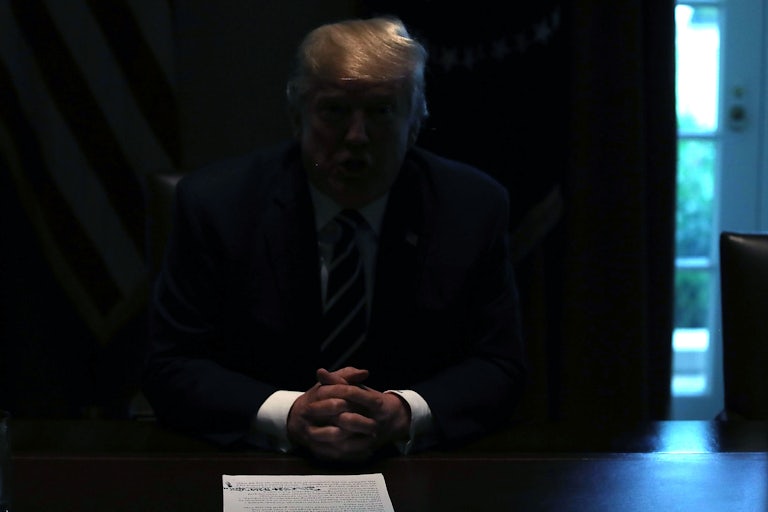
Everyone knows that Aileen Cannon, the Florida federal judge who will oversee Donald Trump’s trial on charges that he illegally kept classified documents, is in the tank for him. Cannon has already gone out of her way—and broken with long-standing precedent—to show her loyalty to the man who appointed her to the federal bench. But other aspects of her judicial record are now being scrutinized.

According to a Friday morning report from Reuters, Cannon has made a number of costly errors on the federal bench. This is not especially surprising given her overall lack of experience—she was appointed to her current position after only 12 years as an attorney. In a June trial, that lack of experience caused significant problems. While overseeing the trial of an Alabama man who had been accused of spreading images of child sex abuse online, Cannon closed jury selection to the public—a violation of the defendant’s Sixth Amendment right to a public trial. In the same case, Cannon also forgot to swear in the jury pool, a mistake that forced the judge to restart the jury selection process. The case ended with the defendant pleading guilty before it could go to trial.

The errors, however, only underscore Cannon’s lack of experience. The earlier mistake, Stephen Smith, a professor at the Santa Clara School of Law told Reuters, was “a fundamental constitutional error.”

“She ignored the public trial right entirely. It’s as though she didn’t know it existed.” The mistake suggests more trouble ahead as the former president’s second criminal trial moves forward.

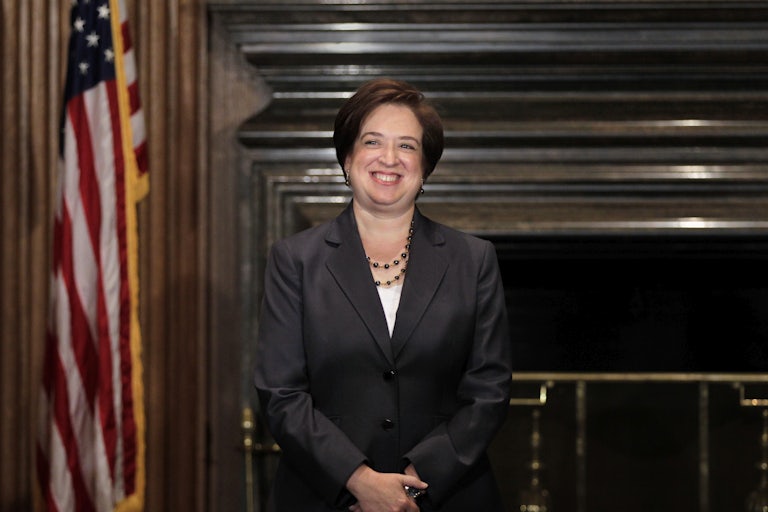
Elena Kagan Hits Back at Samuel Alito, Endorses Supreme Court Ethics Reform

At least one Supreme Court justice thinks something needs to change.

Supreme Court Justice Elena Kagan has broken ranks with some of her colleagues—most notably Samuel Alito—to call for a formal code of ethics for the nation’s highest court.

The Supreme Court has been mired in controversy since the spring, in the wake of reports that Justices Clarence Thomas and Samuel Alito have accepted lavish gifts from billionaire Republican donors. Many people have called on the court to establish an ethics code to help prevent such situations in the future—which the justices have resisted.

But “it just can’t be that the court is the only institution that somehow is not subject to checks and balances from anybody else. We’re not imperial,” Kagan said Thursday at a judicial conference. “Can Congress do various things to regulate the Supreme Court? I think the answer is: yes.”

It’s hard to see Kagan’s comment as anything other than a direct response to her fellow justice Samuel Alito, although she said it was not. Alito recently said Congress should back off from trying to regulate the court.

“I know this is a controversial view, but I’m willing to say it,” he said in an interview with The Wall Street Journal. “No provision in the Constitution gives them the authority to regulate the Supreme Court—period.”

This is untrue, as Section III of the Constitution explicitly says that Congress can determine how to organize the court, and Kagan stated as much. “Of course, Congress can regulate various aspects of what the Supreme Court does,” she said. “Congress funds the Supreme Court. Congress historically has made changes to the court’s structure and composition. Congress has made changes to the court’s appellate jurisdiction.”

Chief Justice John Roberts has also begged Congress to stay out of the court’s business—but that may be because he has since come under fire for shady behavior too, albeit of a much less brazen variety than his colleagues Thomas and Alito. His wife, Jane Roberts, has allegedly been paid more than $10 million by multiple law firms—at least one of which argued a case before her husband, after it had already paid her hundreds of thousands of dollars.

Thomas has for years accepted hundreds of thousands of dollars’ worth of gifts from GOP megadonor Harlan Crow, in the form of island-hopping yacht vacations. The Nazi memorabilia collector also paid for Thomas’s nephew’s tuition, and he bought a Thomas family property, where Thomas’s mother still lives.

Thomas also has repeatedly refused to recuse himself from cases that relate to the January 6 riot—despite the fact that his wife, Ginni Thomas, is a major right-wing activist who encouraged then–chief of staff Mark Meadows to overturn the election.

Alito accepted a luxury vacation from a billionaire Republican megadonor as well. Right-wing activist (and then–head of the Federalist Society) Leonard Leo helped organize the trip, and also attended.

And the scrutiny is not limited to the conservative justices: Justice Sonia Sotomayor is under fire after the Associated Press reported that her staffers pressured institutions where she was scheduled to speak to buy hundreds, even thousands, of copies of her books.

Congress finally made a move to rein in the court two weeks ago, when the Senate Judiciary Committee advanced a bill that would require the justices to adopt a code of ethics. The measure would create rigorous new financial disclosure rules, as well as establish a process for submitting and investigating ethics complaints against the justices.

The bill will have a hard time passing the Senate, though, where Democrats have a razor-thin majority. It is unlikely to pass the House at all because the chamber is controlled by Republicans, who have accused the left of trying to “delegitimize” the Supreme Court (although the court seems to be doing that just fine on its own).

The GOP’s New Trump Defense: Juries Are Bad

Republicans want Trump’s conspiracy trial moved because Washington D.C. is too Democratic.

Photo by Samuel Corum/Getty Images
Donald Trump speaking at a rally in Washington shortly before his supporters stormed the Capitol on January 6, 2021

Republicans are demanding that Donald Trump’s trial for trying to overthrow the 2020 election be moved outside of Washington, D.C., suggesting that he won’t get a fair trial in the city because a lot of Democrats live there.

Trump was arraigned Thursday in the nation’s capital for attempting to overturn the election. He pleaded not guilty to four counts of conspiracy to defraud the United States, conspiracy to corruptly obstruct an official proceeding, obstruction of and attempt to obstruct an official proceeding, and conspiracy against the right to vote.

The GOP, which has staunchly maintained that he did nothing wrong, has now begun to insist that there’s no way Trump will get a fair trial in Washington. “Washington, DC is a ‘swamp’ and it is unfair to have to stand trial before a jury that is reflective of the swamp mentality,” Florida Governor Ron DeSantis, who is theoretically running for president against Donald Trump, tweeted. He also admitted he has not read the indictment yet.

By “swamp mentality,” he likely means “left-leaning.” Washington is an overwhelmingly Democratic city, and 95 percent of residents voted for Joe Biden in 2020. On Thursday, only a handful of Trump supporters showed up to the courthouse, while nearly 100 people stood outside to celebrate Trump’s arrest.

That doesn’t mean the city’s potential jurors can’t do a fair job, though. And the answer is not to move the trial to the “politically unbiased nearby State of West Virginia,” as Trump has demanded. Trump’s lawyer John Lauro has also pushed to move the trial to West Virginia. (By the same logic of why Washington would be biased, Trump won West Virginia by more than 30 points in 2020, his second-largest margin of victory in the election.)

The answer is to leave the trial exactly where it is. The Sixth Amendment of the Constitution states that “in all criminal prosecutions, the accused shall enjoy the right to a speedy and public trial, by an impartial jury of the State and district wherein the crime shall have been committed.”

Trump is not just accused of conspiracy and obstruction; he is accused of conspiring and obstructing in Washington. The only person Trump has to blame for the location of his trial is himself.

More on Trump's (Third) Indictment

Ron DeSantis’s Reset Needs a Reset

The struggling presidential candidate is banking on Iowa to win the nomination. It’s not going well.

Photo by Stephen Maturen/Getty Images
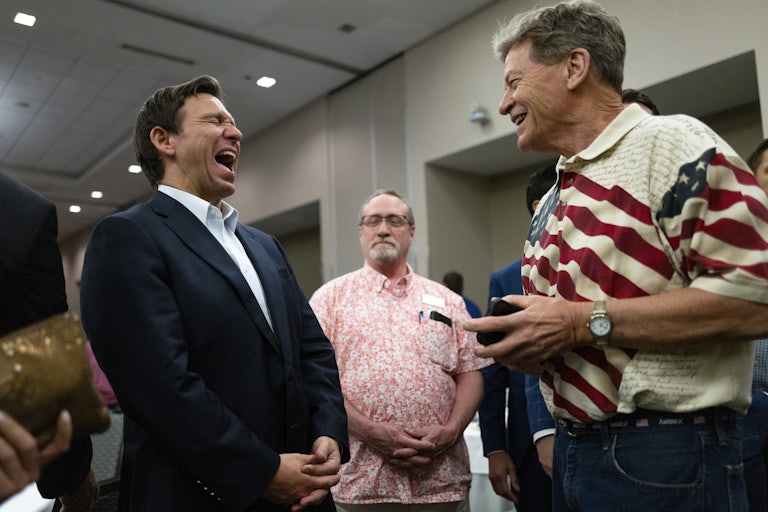
Ron DeSantis being normal in Iowa.

Ron DeSantis’s presidential campaign is not going well. The Florida governor has money problems. He has charisma problems. But mostly he has a Donald Trump problem: His candidacy is based on the idea that he is electable and competent and yet he is lagging far behind his main rival while running an inept, flailing, campaign.

Still, presidential campaigns can change on a dime and DeSantis has long banked on doing well in early primaries and caucuses and using that momentum to capture the nomination. In keeping with that strategy, he has spent seemingly as much time in Iowa as he has in his own state of Florida—despite the fact that he is, at least ostensibly, the governor of the Sunshine State. There have been times over the past few months when it seems like he’s running for president of Iowa as much as he is running for president of the United States. He is in the state practically every week. He even suggested he would consider Iowa Governor Kim Reynolds as his running mate.

And yet it has gotten him almost nowhere. On Friday, The New York Times closed out its week of polls with a survey of Iowa voters. The Times did its best to put a positive spin on the results. Donald Trump, they found, is doing 10 points worse in Iowa than he is in the country as a whole: Only 44 percent of voters in the state plan on caucusing for him at this time. But this is hardly good news for DeSantis: He is only doing three points better in Iowa than he is nationally. Twenty percent of Iowans support him, compared to 17 percent nationally. In a head-to-head matchup between the two—something that almost certainly won’t happen—DeSantis still lags far behind. Trump leads him 55 to 39 percent when the choice is whittled down to the two front-runners, though there is a sliver of good news: Those numbers are more or less flipped among college-educated Republicans.

Still, this is yet another dreadful sign for DeSantis. He needs an early win to show Republicans that he can take on Donald Trump. Yes, the caucuses are a long way away. But there’s no evidence that DeSantis’s strategy is working, even after an early reset.