Newsletter
Power Mad
A weekly review of the rogues and scoundrels of American politics

Hit Corporate America Where It Hertz

The rental car agency is getting away with subjecting its customers to false arrests and imprisonment. How bad do things have to get before there are real consequences for bad behavior?

Cindy Ord/Getty Images

What kind of criminal activity must a corporation commit to face real consequences—for the justice system to compel the company into nonexistence or jail its executives? In recent weeks, there has been some cheerful news on that front: Sunny Balwani, the president of Theranos, will join his former flame and company founder Elizabeth Holmes in a lengthy prison sentence—a deserved punishment for their outlandish lies about their fraudulent blood-extraction machine.

But for every Theranos, there’s a Wells Fargo, who readers might remember as the ne plus ultra example of a bad bank, its executives seemingly bent on finding newer and more innovative ways to scam its customers. Wells Fargo has been given permission to constantly apologize for its wrongdoing and immediately return to it, with no one facing real consequences. The truth is, instances like Theranos, where clear-cut corporate criminals face clear-cut punishments, are considerably rare. All of which brings us to Hertz, which this week joined the ranks of those who’ve gotten away with egregious malfeasance.

Hertz, a car rental firm that’s joined at the balance sheet with several other well-known brands (Thrifty, Dollar), made some blink-and-you’ll-miss-it news: It was forced to “pay about $168 million to settle disputes with hundreds of customers,” reported The New York Times. “Disputes” puts it too politely. Over the course of many years, the company sicced the police on its own customers, who were wrongly accused of having stolen vehicles. This was all due to Hertz’s error: The company mistakenly misclassified cars as stolen or failed to account for customers making payments to extend their rentals.

As CBS News reported a year ago, dozens of customers were wrongly subjected to terrifying encounters with police. But some customers were subjected to even worse. According to the Times, one woman who was arrested, despite having paid her rental extension, was jailed for 37 days—during which time she was “separated from her fiancé and two children, missed her nursing school graduation and discovered she was pregnant.” Another renter, after learning there “was a warrant for his arrest on charges that he stole a Hertz car, had actually paid for and returned the vehicle.” But after he missed a hearing date, he was “arrested again, and jailed for six and a half months.”

Now a $168 million fine might seem like a lot, but it pales in comparison to the company’s $7.3 billion in revenue and $19.7 billion in assets at the end of 2021. Additionally, no company executives have been punished for what amounts to a wholly fraudulent exploitation of the criminal justice system.

Hertz was a troubled firm beyond the crimes it committed; the company filed for bankruptcy during the pandemic, and its employees are thus familiar with their jobs being at risk. But this episode still provides an illuminating example of why our labor politics needs a big rethink. Firms do things all the time that put jobs at risk. Sometimes they commit crimes. Sometimes an idiot just acquires a company and starts firing everyone who won’t join his inane ego trip. An economy in which employers have to compete for labor allows workers to be more mobile and more capable of leaving bad jobs behind, which can help soften the blow whenever the justice system lowers the boom on bad corporate actors. Moreover, this episode is simply the latest and greatest example of why it pays to have a unionized workforce.

But an even better solution would be to promote and enact policies granting workers larger ownership stakes in companies like Hertz. This would give workforces that are already too vulnerable to the errant whims of overpaid executives more transparency into the decisions cascading from the company boardroom as well as a better opportunity to prevent bad, costly actions that put workers’ jobs at risk. Democrats have, in the recent past, proposed such ideas; as The New Republic’s Osita Nwanevu noted in May 2020, polling from YouGov indicated that there was broad support for them among voters, including for “policies incentivizing the voluntary transfer of ownership stakes to employees, and even making companies with more than 250 employees grant those employees half of their stock over time.”

Without the emergence of a course-altering remedy, we will be stuck with a status quo in which we have to hope that slap-on-the-wrist financial penalties will be enough to steer our corporate masters onto more just and prudent paths. The New York Times’ reporting offered some insight into how that will play out at Hertz: “On Monday, Hertz said it believed it would recover a ‘meaningful portion’ of the settlement amount from its insurance carriers and that the $168 million would be paid by the end of this year.” The system works, just not for you.

This article first appeared in Power Mad, a weekly TNR newsletter authored by deputy editor Jason Linkins. Sign up here.

The GOP’s “New Direction”: More Extremism

If you think that Republicans have learned any lessons from their disappointing midterm election showing, think again.

William Edward/Getty Images
Far-right white nationalist Nick Fuentes recently made news after dining with former President Donald Trump at Mar-a-Lago.

During the Trump era, one of the best running jokes was the media’s near-desperate search for signs that the president was shedding his obstreperous tendencies and settling into a new, earnestly presidential tone. Every moment when Trump managed not to opt for the maximally rancid reaction was one in which, perhaps, the “new tone” was taking hold, thanks to some phantasmal moderating influence that was sure to carry the day.

Alas, this dream never materialized, but that’s not to say evolution didn’t occur: Trump swiftly adopted to life as a bog-standard Beltway Republican. And his party grew more comfortable with its standard-bearer’s political aesthetics—all the better to please its base.

But now that the GOP’s big midterm ambitions have fallen apart, political touts are once again trying to conjure a “new tone” narrative into existence; one in which the Republican Party has learned the error of its ways. Some conservative luminaries, after all, have demonstrated a reluctance to fully jump back into Trump’s arms. Former Pence aide Marc Short suggested on CNN over the weekend that something new is afoot: “Since the election in 2020, [Trump] has descended deeper into the heart of darkness. It’s another reason why I think Republicans are looking in a different direction in 2024.”

There’s little doubt that Pence, who is allegedly running for president, would indeed require Republicans to look in a different direction, considering most of them think of Pence as either someone who did too much to enable Trump’s worst tendencies or someone who did too little to keep him in power. But outside of the wishful thinking of Pence and others, there is scant evidence that conservatives truly are ready to change their ways. Has everyone forgotten that Republicans and their donors went to elaborate lengths over the past two years to enact voter suppression laws and boost the political ambitions of election deniers? Because the voters sure didn’t.

More to the point, let’s recall that the context for this past weekend’s expressions of agita over Trump was his decision to break bread with two flamboyant bigots: rapper Kanye West and far-right media gadfly Nick Fuentes. Here was a golden opportunity for this change in direction: Trump’s presidential rivals were gifted the chance to jump into an “at least I’m not a rabid antisemite” lane ahead of the shadow primary.

Sadly, that lane remains unoccupied by any would-be 2024 aspirants. At least one Republican whose 2022 electoral fate remains hanging in the balance, Herschel Walker, is still mum on the matter of whether it was a good idea for Trump to dine with these reprobates. And it took the rest of the Republican Party a number of days to finally register some mealy-mouthed condemnations of Trump’s antics. This is hardly a surprise: An October 6 tweet from the GOP’s House Judiciary account—reading “Kanye. Elon. Trump”—gave proof through the midterms that Republicans were excited to get in on the ground floor of Kanye West’s antisemitism. (That tweet was finally taken down on Thursday shortly after West expressed an affection for Adolf Hitler during a lengthy interview on Alex Jones’ Infowars.)

Fuentes and West may never become keynote speakers at CPAC, but they’re in a decaying orbit around a party that already countenances no end of grotesqueries, from Viktor Orbán’s stoking of authoritarianism to the now regular evocations of the racist “great replacement theory” on Fox News’ prime time. And the person thought to be the heir to Trumpism, Ron DeSantis, has, if anything, grabbed Trump’s baton and sprinted off in the same direction. As Jonathan Chait recently noted in New York magazine, DeSantis “would reify [the GOP’s] Trump-era transformation” by “preserving” Trump’s extreme coalition of “QAnon supporters and insurrectionists.” DeSantis’s constant anti-LGBTQ rhetoric is central to his appeal; he has already emerged as the “Pizzagate in every city” candidate.

We needn’t wait for DeSantis, though. As The Washington Post’s Karen Tumulty notes, the Republican rot is deep in Washington already: “Come January, there will be fewer Republicans left in Congress willing to speak out when Trump does what he keeps doing.… And those who have followed Trump’s example in associating themselves with extremists and their ideas will have more clout within the institution.” And if you’re looking to see exactly how concerned the Republican Party is about its poor midterm showing, the good news is that the RNC is empaneling a team to examine what went wrong. The bad news is that Blake Masters, a 2020 election denier who spent a large part of his Senate campaign cosplaying as a serial killer, is one of those tasked with divining what went wrong. Yep, folks, they’re all just trying to find the guy that did this.

There is a nonzero chance that Trump’s bid to reclaim the throne will come to naught. But let’s be real: Republicans aren’t clamoring for a moderate to take this party in a new direction. “Never Trumpers” are still verboten in the GOP, and no one within that clan seems to actually have any plan to recapture the party’s institutions, aside from heaving op-eds at it. The Republicans coming to Washington plan to stage mock trials of Hunter Biden and use the debt ceiling as a weapon to try to enact radical cuts to Social Security.

As TNR contributor Graham Gallagher recently explained, the educated elites in this party have become decadent and off-putting weirdos, in thrall to bizarre and un-American ideas that seem custom-designed to turn the stomachs of normal people. Meanwhile, the conservative movement’s media propaganda organ is regularly bleating out the same kind of rhetoric as embarrassment du jour Nick Fuentes. So are Republicans really looking for something new? The only direction this party is headed is toward the gutter; the only question is who in the media, expecting a “new tone” or a “change in direction,” will get dragged there with them.

Guess What, It’s Abolish-the-Debt-Ceiling O’Clock (Again)

If the Democrats don’t use the lame-duck session to take this economic doomsday device out of the incoming GOP’s hands, God help us all.

Paul J. Richards/Getty Images
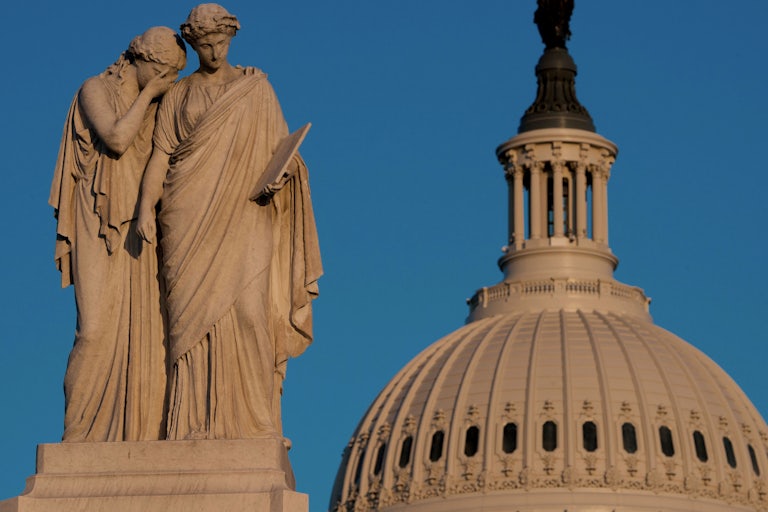
Statues depicting Grief and History stand watch over the Capitol, ruing its denizens’ error-plagued reign.

It’s said that the conventional definition of insanity is doing something over and over again and expecting different results. But what do you call someone who spends their time writing about insane people bent on repeating their insane mistakes, even though that person knows full well that they’ve failed in each and every one of their previous attempts to persuade the aforementioned twonks to stop the madness? Well, for now, you can call that person “me,” because here I am once again, red flags aloft and klaxons screaming, to warn about the potential disaster if Congress fails to raise, or preferably abolish, the debt ceiling. Abolishing the debt ceiling is a thing that lawmakers should have done a long time ago. They will have another chance to fix this in the upcoming lame-duck session. And they almost certainly won’t.

The midterm elections may have broken for Democrats in surprising ways, but they’re ending on very bad terms for those of us who’d prefer to avoid the apocalyptic results of a debt ceiling breach. The GOP will soon be in control of the House and will have to furnish the requisite number of votes to form a majority (presumably with all available Democrats) to stave off debt ceiling doomsday. The tight margins may yield enough votes, but this isn’t a particularly great era for “reasonable Republicans,” and so the worst-case scenario remains on the table. Unless, of course, Congress acts fast and does the deed during the upcoming lame-duck session.

But as The New Republic’s Grace Segers explained this week, the lame duck is already going to be action-packed. There are already a ton of legislative tasks that lawmakers want to try to speed through before the next Congress is sworn in, and different lawmakers attach different levels of priority to each item on their to-do list. I hate to get in the way of everyone’s particular hopes and dreams, but I must: The big thing Democrats need to do in the next few weeks is solve this looming crisis—again, preferably by abolishing the debt ceiling.

TNR readers are probably already familiar with the vagaries of the debt ceiling, but journalistic convention demands that I now furnish an “explainer,” so feel free to skip this if you are not one of the clowns currently sitting in Congress. Congress’s job is to spend taxpayer money. It does this by passing laws and allocating funds. And then, because we’re ridiculous, the legislative branch must, from time to time, affirm that it’ll honor those commitments that get laid on the nation’s balance sheet. This activity is called “raising the debt ceiling.”

Despite what you may have heard, it doesn’t add to or create any new debt. It’s just a promise to pay the bills. And it’s an important promise because if we fail to raise the debt ceiling, it could cause a default of our sovereign credit, and because a lot of the world’s economy is tethered to our own, a default could send a destructive shock wave throughout the global financial system.

It seems nuts that someone gave our ridiculous Congress an “ECONOMY GO BOOM” button, but for years everything went off without a hitch. Whenever the debt ceiling came up, lawmakers would give grandstanding speeches about the other party’s spending priorities, and a few would cast symbolic votes against raising it, knowing all the while that the votes to raise it were secure. What went wrong? Well, when President Barack Obama entered his Grand Bargain era, he raised the notion of using the debt ceiling to negotiate over bigger things. But he forgot that the Republicans were lycanthropic weirdos obsessed with lying about his birthplace and bent on making him a one-term president. So rather than enter into reasonable talks with the White House, the GOP instead enshrined debt ceiling brinkmanship as part of its party’s platform. The Republican Party has increasingly become a home to absolute nitwits with extremely kooky ideas about what might happen if the debt ceiling is breached.

Frankly, it’s nigh on deranged that Democrats didn’t abolish the debt ceiling during these past two years when they had full control of Congress and a mandate to govern. But much like how there aren’t enough Democrats willing to get rid of the filibuster, there haven’t been enough who agree that bringing a loaded gun into the chamber and debating whether it should be fired straight into the face of the global economy is a bad idea.

President Joe Biden, however, had a front-row seat to the debt ceiling chaos of the Obama administration, and he has wisely called for—wait, hold on, what the absolute fuck: It says here that Biden apparently “opposes eliminating the debt limit altogether as a means of averting future confrontations,” on the grounds that doing so would be “irresponsible.” Terrific, Biden has it precisely backward.

Action must be taken now, in the lame-duck session, to put an end to this, because the witching hour is nigh and the GOP will have strong incentives to try to tank the economy. Taking their ability to hold the debt ceiling hostage away from them is a no-brainer. And solutions, from the sublime to the ridiculous, abound: Reinstitute the Gephardt rule; take the advice of The New Republic’s Matt Ford and raise the debt ceiling to one googolplex dollars; mint a trillion-dollar platinum coin and stash it at the Treasury. We could also abolish it outright; we’re just about the only nation with a “debt ceiling,” and no one else on earth has used theirs to create a recurring Saw sequel with the global economy. Or we can do none of those things and Republicans can blow up the economy. Either way, I won’t have to write this again, so at least I have that going for me.

This article first appeared in Power Mad, a weekly TNR newsletter authored by deputy editor Jason Linkins. Sign up here.
Biden’s Democracy Argument Worked

The pundits thought the Democratic Party’s closing argument for the midterms was going to end in certain disaster. Swing and a miss!

Alex Wong/Getty Images

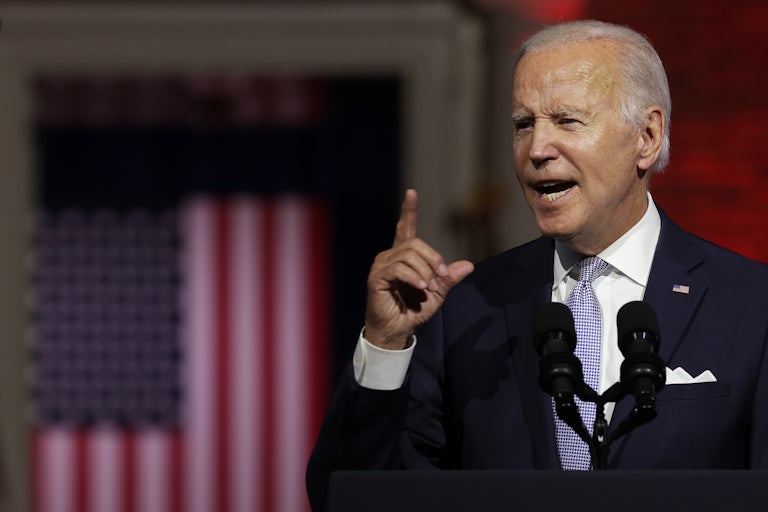
In the last two weeks of the election cycle, as the news seemed to be getting worse and worse for Democrats hoping to avoid a historic midterm election shellacking, party leaders opted to go all in on one particular theme—that democracy itself was on the ballot. Here, voters had a historic choice to make: Vote to save the republic, or squander it. Across the aisle, the GOP had marshaled an army of candidates behind election denialism and a vision of an illiberal United States. In his final campaign speech, President Joe Biden told the crowd assembled at Bowie State University in Maryland that the country was at “an inflection point.”

“We know in our bones that our democracy is at risk, and we know that this is your moment to defend it, preserve or protect it, choose it,” he said.

It was a tall order. And let’s face it, it was a little bit belated. As we’ve chronicled on these pages, Democrats haven’t always spent the past two years as democracy’s most ardent defenders. Too many senators preferred to keep the filibuster rather than get rid of it to pass the laws necessary to confront a well-organized and well-funded effort among Republicans to curb voting rights across the country. Even the Biden administration seemed dismissive at one point, referring to voting rights as just one more niche issue among many.

But when Democrats finally put the defense of democracy front and center in their midterm messaging, the wave of skepticism from the media wasn’t rooted in any past failures or prior fecklessness. Rather, it was spawned by the pundit class’s disbelief that demonstrating fealty to the ideals of our Founders was the correct thing to do to win an election.

CNN’s Chris Cillizza called Biden’s defense of democracy oration a “head-scratchingspeech and “a strategic blunder given what we know about the electorate and its priorities.” Meanwhile, Politico’s Playbook called it “important” but “puzzling” and gave a wide array of voices the freedom to criticize the decision on various grounds, from the fact that the president had already given a widely reported speech on the same subject some weeks before to the concerns of Democratic strategists like David Axelrod, who thought that “as a matter of practical politics, I doubt many Ds in marginal races are eager for [Biden] to be on TV tonight”—the idea being that his poor approval ratings made him a dubious messenger in any event.

In truth, you wouldn’t be thought entirely daft if you fretted that Democrats were, at the very least, talking over the heads of the electorate. Polls ahead of the midterms consistently showed that matters such as the January 6 attacks weren’t foremost on people’s minds; democracy defense seemed like a bad bet. But the exit polls told a different story. Per Axios: “National polling showed abortion and democracy turned out to be big issues with voters. Coverage in the run-up to midterms had focused heavily on pocketbook issues.” In other words, the Democrats’ plan worked, and the media whiffed badly in their read of the electorate’s mood.

For all the anxiety over Biden’s approval ratings, no one seemed to have considered whether the vision of the future of democracy that the GOP spent the year articulating wasn’t even more toxic. This is a party that’s embraced book bans and LGBTQ discrimination, bomb threats at children’s hospitals, and Proud Boys terrorizing drag performers. They’ve discarded the legal roots of the right to an abortion and are eyeing doing the same thing to contraception and marriage equality. Republicans have embraced violent QAnon adherents and become Viktor Orbán fanboys. Does any of this sound like the stuff normie America wants?

And if you want to talk about polarization, let’s talk about how polarizing young voters found the GOP’s message. According to exit polls, voters between the ages of 18 and 29 broke for Democrats by a margin of 63 to 35. This makes sense: Every conservative denunciation of “wokeness” is, at bottom, a proclamation that Republicans shall not allow the youngest Americans to live the lives they want; their massive effort to suppress the vote is, in the end, just a plan to deny the youngest Americans their right to shape the nation they’re inheriting just as they’re becoming regular voters.

Still, I think a lot could have gone wrong with the way Democrats messaged around a defense of democracy. When Biden trotted out “ultra MAGA” some months ago, I worried he was more likely to energize the opposition than rally his own troops. But more recently, I heard one of Pennsylvania Governor-elect Josh Shapiro’s final campaign speeches, and I realized just how much power this closing argument could marshal.

I’m not letting Doug Mastriano take away your vote.… That is not how things work in this commonwealth or in this country. That’s not how our democracy works, and that’s not what freedom is all about.

This guy loves to talk a good game about “freedom” all the time. Right? We’ve heard that. Let me tell you something: It’s not freedom to tell women what they’re allowed to do with their bodies. Right? That’s not freedom. It’s not freedom to tell our schoolchildren what books they’re allowed to read. That’s not freedom. It’s not freedom to tell workers they can work a 40-hour workweek but they can’t be a member of a union. That’s not freedom. And it sure as hell isn’t freedom to say, you can go vote, but he’s gonna pick the winner. That’s not freedom. That’s not how we do things here in Pennsylvania.

This is the way to talk about democracy: not as something that only started mattering because Donald Trump came along to piss on it but as the great provider of the gifts of the good life—prosperity, stability, and dignity. Democracy is also something that has enemies, who should be cheerfully and confidently named and shamed.

Obviously the fight is far from over; lots of illiberal Republicans won this week. And now that democracy is “off the ballot,” Democrats need to help everyone who cast a vote to preserve democracy find new and creative ways to tend to it in all the days that come between elections. But we can put any skepticism about the “message” to bed. The fight for democracy is a good fight, and it’s good that the right people found a way, while facing long odds, to draw a line in the sand and punch the bullies in the mouth. More of this, please!

An earlier version of this article first appeared in Power Mad, a weekly TNR newsletter authored by deputy editor Jason Linkins. Sign up here.
Will Elon Musk Ruin Twitter? That’s the Wrong Question.

The Tesla mogul has taken up ownership of a company that may not have much of a future with or without him.

Twitter account of Elon Musk/Getty Images
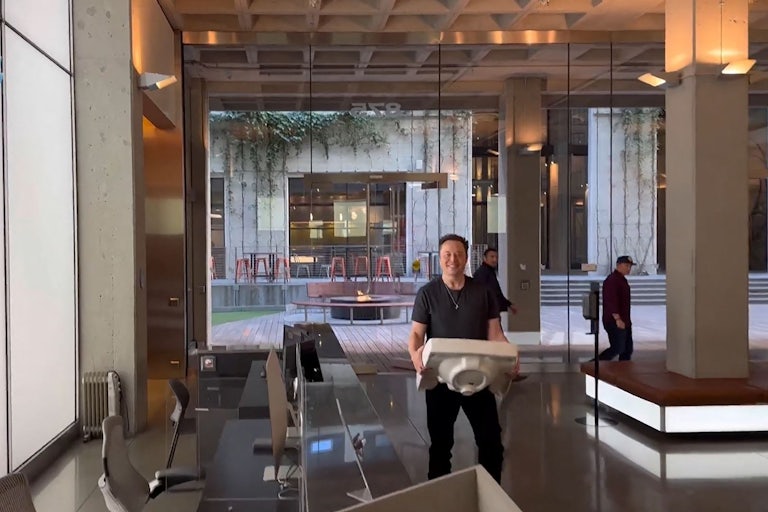
Elon Musk visits Twitter’s San Francisco headquarters.

Tesla founder and professional online griefer Elon Musk paid a visit Wednesday to Twitter’s San Francisco headquarters, carrying a sink to execute a visual pun I won’t condescend to explain here. This was the beginning of a significant week in the life of Musk and the company. The headline-making deal that has left the venerable social media firm in his hands has, after fits and starts, come to fruition. Employees were invited to say hello to Musk as he swanned about the building—a dicey proposition given that Musk had announced that he’ll be shedding three-quarters of the firm’s workers as one of his opening moves.

As Musk neared the completion of a transaction that he may end up regretting, there was a lot of “last week of Twitter” talk circulating. The fears are not entirely unfounded: If Musk carries out his planned purge, people more deeply invested in knowing how Twitter works predict that the move will likely have a “major impact” on the company’s “ability to control harmful content and prevent data security crises.” Of course, for all anyone knows, Musk won’t gut the workforce in this fashion—in fact, while he immediately made a series of splashy firings, he already appears to be walking back this threat. This is typical Musk: His favorite commodity to manufacture, after all, is bravado, which is probably why he wants to be the “chief twit” at the internet’s biggest hot-take mill. It’s very possible to overstate Musk’s malevolence. But as I listen to the doomsaying, I’m reminded that it’s equally possible to overstate Twitter’s importance.

What does it actually mean for Twitter to “end”? Is it going to be like when Friendster ended? Is it going to be like when we all stopped using manual typewriters? If and when Twitter meets its final demise, it stands to reason that we’ll not easily replace it. As Garbage Day’s Ryan Broderick notes, there aren’t “any platforms well-established enough to collect Twitter refugees all at once,” and there’s no guarantee that one will. Twitter has, over time, accreted a bunch of different functions that make sense in its skin but aren’t necessarily worth another company replicating. “Historically,” Broderick argues, “the exact features of a dead platform never really come back.”

But it’s one thing to feel wistful about the platform that allowed us all to gasp together when Will Smith smacked Chris Rock in the face; another thing entirely to feel anxious about the possibility that this one may fall into crapulence. I think that most of these fears are based on a misapprehension that Twitter is some kind of manifestation of “the public square”—something that Musk himself still seems to believe as well (though his vision for this public square is less content moderation and more advertising, two ideas he does not understand are in tension with each other).

Here’s the good news, however: Twitter isn’t a “public square.” I don’t mean to downplay the way this platform can and sometimes does have uplifting effects on people’s lives and careers. But you can’t have a public square without the public, and the public has proven itself to be very resistant to Twitter’s charms. A study by Pew Research found that fewer than one-quarter of U.S. adults use Twitter at all. Of this sliver of the population, an even tinier cohort is responsible for the vast majority of tweets: “The top 25% of users by tweet volume produce 97% of all tweets, while the bottom 75% of users produce just 3%.”  

As it turns out, Twitter really is just a weird bubble of self-selecting outlier freaks; we’re disproportionately elite but largely unfollowed by the masses. We’re loud and we’re persistent and we’re representative of nothing in particular. And if what we were doing on Twitter was some kind of threat to the powers that be, well, there would probably already be a well-funded campaign to stop us from tweeting, the way there is a well-funded campaign to strip Democrats of their voting rights.

Besides, there’s another way of thinking about Musk’s acquisition of Twitter. It may be that the very reason it’s happening is precisely because Twitter is already well on its way to becoming a distressed asset without Musk’s influence and thus ripe for the plucking. According to the firm’s own research, Twitter is struggling to maintain the engagement of its most active users, and an overall shift in user interest—from news, sports, and entertainment to cryptocurrency and “not safe for work” content—stands to “make the platform less attractive to advertisers.” 

The picture being painted is of a site struggling to stay relevant and influential, to which Musk is going to tether himself like a subprime mortgage in a doomed effort to refurbish a property that can’t be saved. Even in this regard, we should consider whether more tidal forces are at work. Meta, formerly known as Facebook, is also having epochal problems as its “metaverse” play founders and the company (and its founder) shed market value. Maybe what’s happening right now is simple evolution: Social media’s neolithic age is simply giving way to the next era, and the old dinosaurs are sinking in tar.

At any rate, if you’re in need of an actual public square, there’s always the real thing: public and civic life, political organizing, and citizenship. And more and more, we need more reasonable and sane people in that space. We need more people out in the world to outnumber antisemitic thugs who preach hate on highway overpasses and to show up in greater numbers in rooms where monstrous idiots are bullying children to tears because of their insane belief that the mural they painted is “satanic.” Liberals need to be working, in numbers, at polling places on this Election Day and the next. We can all live with Twitter rotting out from the inside, but we can’t allow the same thing to happen to democracy. If these are the last days of Twitter, let’s embrace the fact that we’ll all have more time to do the things that really matter.

An earlier version of this article first appeared in Power Mad, a weekly TNR newsletter authored by deputy editor Jason Linkins. Sign up here.