The Corporate Miscreants Driving the Affordability Crisis
These 20 firms all have something in common: Their CEOs get paid millions, their workers are being pushed onto public assistance, and voters are fed up with them.

During his recent State of the Union address, President Donald Trump took a few minutes to talk about the affordability crisis that’s been gripping the nation—which is to say, he threw some balderdash in the direction of Democrats. Blaming the high prices he once referred to as a “hoax” on the “dirty, rotten lies” of the opposition party, he then neatly pirouetted into his next point: declaring the crisis over. “Their policies created the high prices. Our policies are rapidly ending them,” he said. “We are doing really well. Those prices are plummeting downward.”
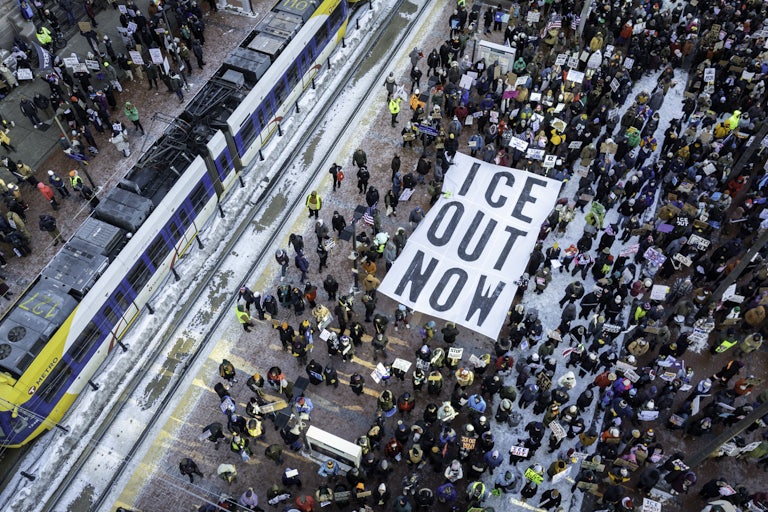
It’s not hard to understand why Trump wishes this to be true. He is, after all, a one-man driver of the affordability crisis. As we’ve noted before, the mayhem he has unleashed on the streets of cities like Minneapolis is making it harder for ordinary Americans to make ends meet. The American people are bearing most of the cost of his chaotic tariffs scheme. And gas prices are set to spike anew now that he’s launched a war in Iran. Still, as with any problem playing out in the pocketbooks of voters, the president has plenty of company on the wrong side of the fight—like the corporate privateers who are driving the crisis deeper while profiting off of our pain.
A new report from the Institute for Policy Studies, or IPS, takes a deep dive into the battery of corporations they call the “Low Wage 20”: 20 firms that currently employ 6.7 million people across the United States. The names are familiar—Amazon, Starbucks, FedEx, Walmart, and Tyson Foods are habitual malefactors—but their sins are growing more mortifying by the day.
The most mortal of these, per the IPS, is the way these 20 firms’ “low-wage business models have left many of their workers with no choice but to rely on public assistance.” Fifteen of the companies’ median pay last year was “below the $35,631 income limit for a family of three to be eligible for Medicaid in most states”; at 13 of them, the pay fell short of the “$33,576 threshold for a family of three to be eligible for SNAP.” It’s bad enough when your business model essentially plans for government programs to provide the money you’re not willing to pay. But as TNR’s Grace Segers has relentlessly reported over the past year, the funding cuts and regulatory hurdles embedded in Trump’s “One Big Beautiful Bill” have pushed these programs, and their beneficiaries, into crisis.
The IPS says corporate power is driving the affordability crisis in other ways, as well, including a very basic one: They’re just paying people less. “Half of Low-Wage 20 firms reported a decline in their median pay between 2019 and 2024, after adjusting for inflation,” the report says. “Average median pay for the group dropped 4.6 percent, from $30,474 (in 2024 dollars) to $29,087.” These workers are increasingly getting priced out of the American dream too. All 20 of these corporate miscreants’ reported median pay last year was below the $59,600 needed to afford the rent on a two-bedroom apartment; seven of the firms’ median salaries are lower than the $25,533 average price of a used car.
Meanwhile CEO pay is doing what it always does—driving income inequality. The average CEO pay at these 20 firms was $18.6 million last year, while average CEO-to-median worker pay ratio “stood at a staggering 899 to 1, compared to the S&P 500 average of 285 to 1.” Brian Niccol of Starbucks took home the award for the most nonsensical disparity between CEO and employee income: He earns $95,801,676, while the median salary for a Starbucks employee was a mere $14,674.
There are a slew of policy decisions that can be made to alter this trajectory, from raising the minimum wage to bolstering labor rights to imposing a tax on stock buybacks. The IPS even suggests we adopt the practice of “bad business fees” designed to penalize companies for paying such paltry wages that their employees have no choice but to rely on public assistance to make ends meet. And of course, corporate democracy would go a long way to taming these excesses. As TNR contributor Osita Nwanevu has argued, more worker ownership can help limit income inequality while also providing firms with ballast to survive economic downturns.
It goes without saying that the ideological orientation of the White House and Congress guarantees little progress will be made on any of these fronts—especially with Trump looking backward to blame Democrats for the wreckage he’s meted out. But November’s elections loom—and as TNR contributor Dylan Gyauch-Lewis reported, poll after poll reveals a public hungry for lawmakers to confront corporate power directly, and that “large majorities of Americans blame corporations for their affordability issues.” There’s never been a better time to make some corporate enemies. These 20 will do for a start.
This article first appeared in Power Mad, a weekly TNR newsletter authored by deputy editor Jason Linkins. Sign up here.