Newsletter
Power Mad
A weekly review of the rogues and scoundrels of American politics

Teachers With Night Jobs at Amazon Are Not a Feel-Good Story

Beneath a teasing, pleasing image lies a tale of unaddressed hardship.

Kerem Yucel/Getty Images
School teachers hold placards during the strike in front of the Justice Page Middle School in Minneapolis.

Have you ever noticed that so much of what’s sold as “good news” these days doesn’t seem all that good? There’s the self-sacrificing Texas teenager who’s helping her mom make ends meet by cashing out her own college fund. Or the Dallas–Fort Worth teacher who’s going the extra mile to keep her students’ achievement levels up by teaching from her hospital bed after cancer surgery. Or, just to provide an example that isn’t from Texas, there’s the 8-year-old kid from Vancouver, Washington, who raised thousands of dollars to pay off his classmates’ school lunch debt. Are we actually supposed to celebrate this? Why are these anecdotes cheerfully portrayed as acts of kindness when they’re actually tales of grim dystopia?

An especially grotesque example of this genre recently floated into my newsfeed from North Carolina. A recent post from the Chapel Hill-Carrboro City Schools Twitter account, purportedly celebrating “Random Acts of Kindness Day,” related the news of a public fourth-grade teacher whose students has written “notes of appreciation for folks at the Amazon Fulfillment Center in Mebane, where [the teacher] is also a full time 5:30 p.m.-3:30 a.m./Mon.-Fri. HR manager.” The tweet continued: “(You read that right!) How kind!”

One would hope that the person who briefly posted about this teacher’s terrible employment situation did so out of some ironic attempt to raise awareness of the plight of North Carolina’s schools. Sadly, it’s an obvious example of what my former ThinkProgress colleague and TNR contributor Jessica Goldstein has referred to as “the feel-good feel-bad story.” “In the feel-good feel-bad story,” she wrote in 2018, “irrefutable proof of an institutional failure is sold as a celebration of individual triumph,” for the purpose of distracting us from “the structures that made such kindness, bravery, and fortitude necessary in the first place.”

The tweet from the Chapel Hill school system perfectly fits the mold of a “feel-good feel-bad” story. The institutional failure is obvious: Apparently, it’s quite difficult to live in North Carolina on either the salary of a full-time fourth-grade teacher or a full-time human resources manager. It’s also not clear when this teacher actually sleeps between the two jobs, given the half-hour commute from Carrboro to Mebane, the inevitable commutes to and from home, and the time this teacher spends working outside of her contract hours, as most teachers in the United States do. But this institutional failure is obscured by a supposed individual triumph that is meant to be a reward in itself, as if the fulfillment this educator allegedly receives from always working and never sleeping is some form of compensation.

Whoever sent this tweet demonstrated at least enough self-awareness to delete it, not long after it started attracting attention. That’s probably for the best, because as one local blogger noted, it surfaced unflattering facts: “A new teacher in North Carolina with no experience makes $37,000 per year (10 months), with a modest bump if they have an advanced degree or certification. The annual salary increases on a regular basis up to teachers with 25 years of experience, who are paid $54,000.” One North Carolina school principal recently summed up their personnel predicament like so: “It is incredibly difficult to find anybody that wants to teach, certainly, anyone that meets the qualifications to be eligible to teach.”

This is a national problem. Teachers are paid substantially less than workers with similar educational credentials. According to a 2018 analysis, “Teachers’ weekly wages lag by more than 25 percent compared to similarly educated professionals in 16 states. There are no states where teacher pay is equal to or better than that of other college graduates.” According to a new analysis by the Economic Policy Institute, that gap has only worsened in the years since. It’s becoming more common for teachers to have to work second jobs or hold down a side hustle, and according to a recent story in EdWeek, “new analysis conservatively estimates that there are more than 36,500 teacher vacancies across the United States, and the majority of states are experiencing teacher shortages.”

And there are solutions that don’t require acts of quiet individual heroism or elaborate displays of appreciation. Vermont Senator Bernie Sanders has proposed a measure called the Pay Teachers Act, which will establish a salary floor of $60,000 for all public school teachers, to be funded by an adjustment to the estate tax that currently allows the wealthiest Americans from sheltering their income from taxation. To Sanders’s mind, “If we can provide over a trillion dollars in tax breaks to the top 1 percent and large corporations, please don’t tell me that we cannot afford to make sure that every teacher in America is paid at least $60,000 a year.”

Our current teacher workforce is hobbled by second jobs and side hustles, which scares off the most talented potential full-time teachers and sabotages our kids’ educations and futures. Perhaps the people on the right who spent the last few years screeching at top volume about “learning loss” might be convinced to lend a hand to Sanders’s effort, and then we can celebrate what would truly be a feel-good story.
Did the Media Get Derailed in East Palestine, Ohio?

Critics who have blasted the press for ignoring the Norfolk Southern disaster have missed the mark, but not by much.

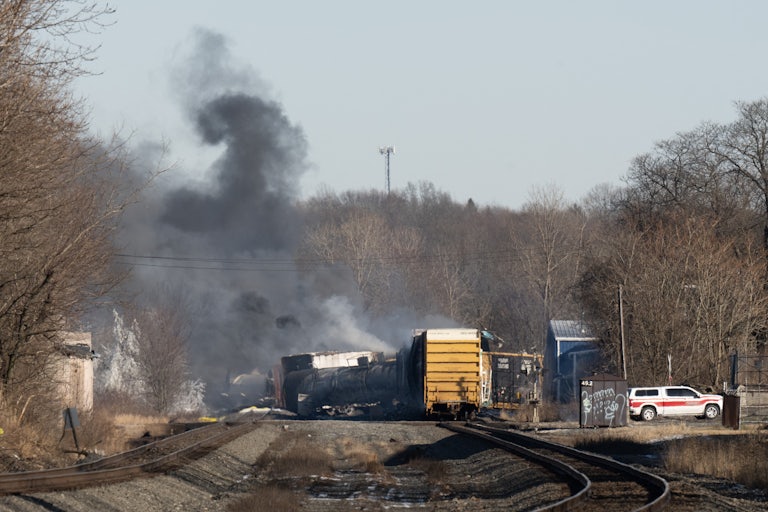
Smoke rises from a derailed cargo train in East Palestine, Ohio.
Dustin Franz/Getty Images
Smoke rises from a derailed cargo train in East Palestine, Ohio.

The February 3 derailment of a Norfolk Southern train and the cinematic environmental disaster that followed has plunged a small Ohio town into chaos. The New Republic’s Prem Thakker spoke with several residents of East Palestine, Ohio, this week, who have told a fairly consistent tale of related woes: sudden and worrying health concerns to humans and pets alike, a lack of guidance from local officials, and paltry offers of compensation from the rail company. The story, as a whole, contains the elements of something truly scandalous—a disaster of Deepwater Horizon proportions. But along the way, accusations of a second scandal have emerged from some quarters, who have accused the media of giving the story short shrift.

Is the accusation fully fair? It may not seem obvious, but for us to know anything about the derailment, some media, somewhere, had to cover it in some way. The truth of the matter is that the story is getting robust coverage, especially where it matters: locally. As Joe Donatelli, the digital director of News 5 in Cleveland explained in a long thread on Twitter, “To say it’s not being covered at all is wrong if you know how to Google.” Cable news channels and major national dailies have also, if somewhat laggardly, covered the story; there’s been no “news blackouts” of the events in East Palestine. Nevertheless, it’s clear that there are obvious expectations among the broader population of news consumers that aren’t being met by the big legacy media outlets.

So what is it that makes sufficient media coverage sometimes seem insufficient? There are some boring reasons: East Coast media bias, as The New Republic’s Matt Ford noted, is real—and it’s an especially galling factor in coverage of the environment. It’s not hard to imagine the western wildfires receiving substantially better coverage if the news industry were centered in California. But the perceived shortfall can’t be entirely attributed to industry shortcomings. Some have to do with the facts on the ground.

We should be thankful that there is not a massive death toll (at least among humans) as a result of the derailment; we can also acknowledge that the lack of casualties makes the story less urgent to some newsroom leaders than, say, the recent mass shooting at Michigan State University. East Palestine’s emergency, moreover, will be slow to unfold. While we’re already getting a good sense that this train crash will have a dire environmental impact, the fuller picture those facts will ultimately present isn’t currently at hand. In fact, we may want to reserve judgment about how well the mainstream media covered this matter until a few weeks from now. When that fuller picture emerges, will the big leaguers still be willing to beat a drum?

The coverage of the derailment also suffered from the fact that cable news and the major newspapers were transfixed by a story that seemed, both at the time and in retrospect, much sillier: the Chinese spy balloon(s). But perhaps the biggest reason the derailment story hasn’t dominated the news cycle is that it lacks a clear and obvious partisan frame, and thus there’s no clean way to fit it into a tidy “left versus right” construct. The Deepwater Horizon disaster was a monumental story in part because its proximity to New Orleans inspired the media to ask if this was “Barack Obama’s Katrina.” With regard to the derailment, we don’t have clear partisan villainy: It’s a product of Republican-backed deregulation and austerity, the Biden-supported quashing of a rail workers’ strike, and years of bipartisan obeisance to shareholder capitalism that created incentives for firms like Norfolk Southern to lengthen their trains without adding upgraded safety measures.

That this failure has so many fathers also adds a level of complexity to confronting the powerful interests involved. There isn’t always a tremendous appetite for these kinds of confrontations at big legacy news organizations of the sort that, say, welcome Pentagon “message force multipliers” or uncritically print the accounts of cops as the first draft of a news story. From many thousands of feet in the air, perhaps the legacy media can see the balloons better, but they’re less attuned to the inequities at the root of these kinds of stories and have less of an understanding that “politics” can best be measured as a force that acts on ordinary people. There’s a reason that TNR’s Thakker was quicker to the punch in getting the straight dope from East Palestine locals than reporters at The New York Times or The Washington Post: We have fewer resources but a keener interest in that aspect of the story.

But there’s something genuinely gladdening to take away from this inquiry into the modern media. Those who’ve been left so vocally dissatisfied by the coverage of the Norfolk Southern disaster are demonstrating good instincts in terms of what should constitute substantive news coverage of the events that shape our lives. What’s more, they’re showing laudable character in their desire not to turn away from strangers in need. There’s no guarantee that there will be some widespread self-correction among the biggest media firms, but without this public consumer demand for a better brand of news, a better brand of news won’t be possible.

This article first appeared in Power Mad, a weekly TNR newsletter authored by deputy editor Jason Linkins. Sign up here.

The Case Against a Biden Run Is Obvious—and Weak

Democrats may fret over the president’s age, but they’re nowhere near ready to replace him.

Jacquelyn Martin/Getty Images

Did The New Republic’s Walter Shapiro just jinx the entire country? It seems as if I was just savoring the afterglow of his recent piece extolling the relative quietude of the pre-presidential primary season when all of a sudden, everything popped off. Nikki Haley announced her intention to run for president. Mike Pompeo put a toe in the water. Then Donald Trump accused Ron DeSantis of being a pedophile. So much for our sea of tranquility!

Still, let’s face it, this was inevitable: The Republicans are going to have a long and pyrotechnic skirmish to decide their presidential nominee. For those hoping for a similar spectacle on the Democratic side, however, reality provides precious little grist. But the world of hot takes and hypotheticals beckons. And this week, we got a classic of the genre in the form of a Michelle Goldberg piece titled, “Biden’s a Great President. He Should Not Run Again,” in which she takes 850 words to reiterate a point she’s already made: Joe Biden is really, really old.

I don’t necessarily want to dump all over this point of view. I share Goldberg’s concern about Biden’s age. When The New Republic’s editor, Michael Tomasky, solicited the opinion of Democratic insiders about whether Biden should run again, it was among their worries as well. Their consensus, nevertheless, was that Biden should run again. It makes sense: Biden’s age was a major concern when he announced his run in 2015. It remained a major concern when Biden’s two biggest rivals in that primary, Elizabeth Warren and Bernie Sanders, also turned out to be very old themselves. Democratic elites and primary voters stared right into the heart of these gerontological anxieties and, having weighed them fully, decisively nixed all of the more youthful alternatives that were running for president alongside their elders. So here we are.

It’s true that Democrats could, if they wanted to, pivot and act on that concern now by using a primary to reverse this prior decision. One major problem they’d face is the lack of compelling alternatives. Democrats have a lot of people on hand whom voters already rejected in favor of Biden. Two of them, Sanders and Warren, don’t solve the age problem. Vice President Kamala Harris barely rated in the 2020 primary and has historic troubles with Democratic Party elites. Most of the rest have done little in the intervening time to advance the idea they should seek higher office, and the prospects for some have only worsened: Beto O’Rourke got absolutely rinsed in his latest attempt to get elected to something.

What about the future? Goldberg claims Democrats have “a deep bench.” She’s only able to name two politicians, Gretchen Whitmer and Raphael Warnock. Take it from someone who watched the Virginia men’s basketball team crash into—and out of—the NIT last year: Two people is not enough for a “deep bench.” Whitmer is one of a few Democrats (I’ll spot Goldberg J.B. Pritzker and Josh Shapiro) who might well round into presidential form, given another few years of seasoning. The notion that Warnock should make an early departure from his hard-won Georgia Senate seat—especially after all he went through to secure it—to take on a quixotic bid for the White House in 2024 is one of the more ludicrous notions I’ve encountered in a while.

Besides, any attempt to solve the dilemma of Biden’s age by seeking a replacement will engender a problem of greater magnitude: It will inject the pre-primary season with a massive dose of unnecessary tumult. Even if Biden had to give way for a clear and obvious reason, the ensuing disarray would touch off a combative primary in an election cycle in which a unified purpose among Democrats couldn’t be more important.

And the pundits who’d sell such a switch as a brilliant tactical decision, as Goldberg has, can’t be counted on to ratify the wisdom of their directive after the fact. Remember: The political media are chaos junkies who treat conflict as catnip and would relish the crisis caused by Biden’s departure. Meanwhile, the lesson of the midterms is that voters are turned off by disarray. Biden’s own polling struggles reflect this: Nothing damaged his approval ratings more than the chaotic withdrawal from Afghanistan. He is still struggling to recover from that one moment when it did not appear that the adults were in charge.

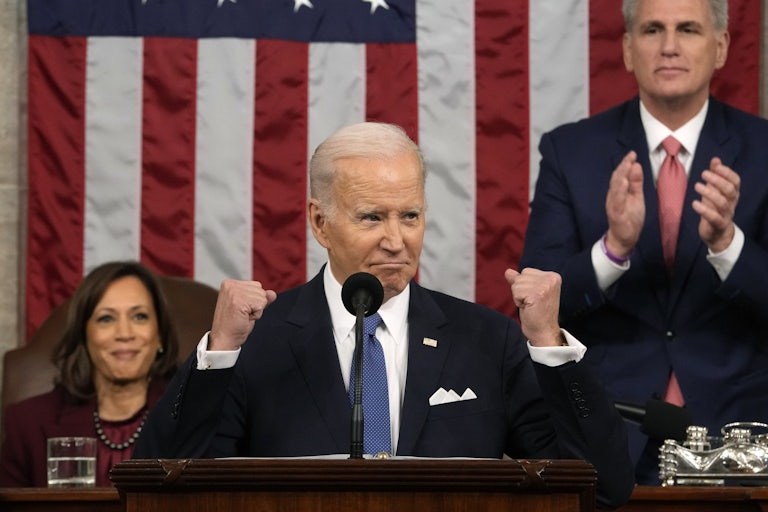
But Afghanistan is instructive in a different way as well. The withdrawal may have hurt Biden’s numbers, but the fact that he was unwilling to keep paying the sunk costs of the Afghanistan scam was a real break from the status quo. Biden’s State of the Union address suggested that the president still has that yen for fresh thinking. As HuffPost’s Kevin Robillard noted: Clinton used his address “to declare the era of big government over, Obama used them to sell a grand bargain and a free trade deal.” Biden, by contrast, “used it to attack big pharma, rule out social security cuts, talk about antitrust policy, and declare the tax code unfair.”

This is a phenomenon that we’ve noted before: Many of Biden’s throwback instincts about the way America could be are incredibly well suited to the moment, and seem fresher than his predecessors’ ideas. Would-be Biden successors should take heed, because at the moment it’s Biden who sounds most like a bona fide party standard-bearer and a better tribune of the middle class than any of the GOP’s weird culture warriors, and more prepared to battle the larger universe of chiselers and cheats who have gotten away with nickel-and-diming ordinary Americans.

This article first appeared in Power Mad, a weekly TNR newsletter authored by deputy editor Jason Linkins. Sign up here.

The Only Debt Ceiling Deal Is No Deal at All

Biden made a vow never to repeat the Obama administration’s worst mistake. His resolve is now being put to a test.

House Speaker Kevin McCarthy speaks to the media after meeting with President Biden.
Chip Somodevilla/Getty Images
House Speaker Kevin McCarthy speaks to the media after meeting with President Biden.

Days of relative calm were few and far between during President Trump’s chaotic reign, but there was one matter about which no one had to fret: For four years, whenever the debt ceiling needed to be raised, Congress made it happen in a fuss-free manner and without worrisome talk about the catastrophic economic impacts of a debt limit breach. But with Republicans in charge of the House of Representatives, the bad old days are here again. On Wednesday, President Biden and House Speaker Kevin McCarthy commenced budget negotiations with a debt limit “X Day” looming.

As CNN reported, Wednesday’s talks were something of a nonevent—precisely what political wags anticipated in the run-up to the meeting. McCarthy emerged from the White House confab with optimistic lines about the potential for common ground. Good news, then: We did not meaningfully lurch in the direction of doomsday this week. But there’s a palpable sense of déjà vu as we tee up what might be this year’s most loaded question for the Biden administration: Will the president keep his vow not to negotiate over the debt limit?

Biden, as vice president in the Obama administration, had a hand in creating the debt limit chaos by deciding in 2011 to seek a “grand bargain” with Republican lawmakers on deficits and long-term spending. Thus began an era in which the two parties were perpetually at an impasse over spending and revenue: a divide so obviously unbridgeable that connecting it to the debt limit only added to the potential for destruction. Still, the Obama White House spun its wheels, chasing a grand bargain through several standoffs, a government shutdown, a credit downgrade, and the sequestration budget cuts that went into effect after Congress’s “supercommittee” failed on its own terms to arrive at a shared set of budget cuts.

This troublesome past is now the ready-made prologue to Biden’s new wranglings with new Republicans. As NBC News’s Sahil Kapur reported last week, when Obama and Biden came to understand the folly of their ways, they made a pledge never to repeat their mistakes, agreeing that from then on “nobody can use the threat of default or not increasing the debt limit as a negotiating tool.”

The early signs are encouraging. Last Thursday, Biden said, “I will not let anyone use the full faith and credit of the United States as a bargaining chip.” The administration echoed that stance in a memo released Monday from National Economic Council Director Brian Deese (who on Thursday announced he was stepping down from that position) and Office of Management and Budget Director Shalanda Young. In it, the two economic advisers said that the president “intends to pose two questions to McCarthy on Wednesday when the two men meet: Whether McCarthy will commit to the U.S. not defaulting on its financial obligations and when McCarthy and House Republicans will release their budget.”

For what it’s worth, Republicans have seemed a little knocked back by the White House’s steadfastness. As Kapur reported in a previous dispatch, Republicans have been “struggling to identify” what to cut and “divided” over whether “Medicare and Social Security spending should be on the chopping block” or “military funding should be on the table.” According to The New York Times, these “internal divisions over how to reduce spending” have since spilled “into public view, underscoring the political challenge that Republicans face as they try to wield the specter of a default to extract concessions.”

If Politico’s reporting is any guide, this is more or less going the exact way the White House drew it up. “The White House strategy,” according to Playbook, “is patience.” The administration is of the belief that “McCarthy is unlikely to craft a budget plan that can secure 218 votes given the internal contradictions within his conference among libertarians, defense hawks, and moderates representing Biden districts.”

Still, it’s in this early stage that it’s easiest for Biden to keep his debt ceiling vow. It’s only going to get harder. With a new analysis from the International Monetary Fund pointing to the easing of inflationary pressures and a global economic rebound, there are going to be tremendous incentives for Republicans to crash the economy as the presidential election cycle gets underway. Push could come to shove, and Biden might have to reach for a parliamentary trick—or, yes, a platinum coin—to avert disaster. But that’s why these tools are at his disposal: to help Biden keep his promise, and keep the world spinning forward.

This article first appeared in Power Mad, a weekly TNR newsletter authored by deputy editor Jason Linkins. Sign up here.

George Santos Is a Model Republican

A growing number of conservatives are calling for the New York lawmaker’s ouster from Congress. But why? He fits in just fine.

Al Drago/Getty Images

You’ll never guess what’s gotten stuck in the craw of the perpetually bothered GOP doyenne Peggy Noonan. This past weekend, the Wall Street Journal columnist took to the paper’s doughty op-ed page to sound off on George Santos, the human falsehood fountain who now serves New York’s 3rd congressional district. In a column titled “George Santos Has Got to Go,” Noonan says that she doesn’t “get why members of Congress would let the George Santos story” drag on. “It diminishes them,” she writes. “It is both a daily insult to the American people and a taunt.” She joins a boomlet of conservatives, from within and without New York, who’ve called for Santos’s exit in recent days.

As The New Republic’s Alex Shephard recently wrote, Santos actually does bring something to the table: His daily cascade of lies and humiliations provides the GOP with a much-needed distraction. Every day, his peccadilloes hit the headlines, pushing down discussion of, say, the crazy “fair tax” on which Republicans are going to vote. Perhaps Noonan and her fellow critics do not share this visionary strategy. But they’re also lacking in perspective. It is said that Santos wanted to find a way to receive lifetime health care coverage and a pension. These aren’t unreasonable things to want. It’s further said that he eyed becoming a member of Congress to get these perks, which is also quite reasonable. And then he arrived at the most reasonable conclusion of all: Where would an inveterate liar and con man be most welcomed in politics? The clear answer was the Republican Party.

Anytime a conservative gets on their high horse about Santos, the derelict lawmaker ends up looking more sinned against than sinning—and not just because it’s clear that plenty of Republicans knew what Santos was all about. Noonan says that Santos “waged war on reality”? Hard to imagine that he wouldn’t be welcome in the party that popularized this practice in numerous ways, rejecting the fruits of science and academia and turning its base against these professions. Noonan complains that Santos has “stolen from voters … a sense of what’s true.” That’s rather rich coming from someone who touts the party that lied the nation into a destructive war.

“The only entity that smoked out a fake was a small local newspaper, The North Shore Leader,” writes Noonan, seemingly unaware of the long war her party has waged to discredit the press, a project that accelerated after Newt Gingrich’s ascension. Does anyone imagine that the GOP is going to play a role in reassembling a robust, adversarial press in the numerous news deserts that have bloomed across the country? Like everything George Santos says, it is not to be believed.

Noonan’s far from the only Republican celebrity who needs to get off the fainting couch and take a look in the mirror instead. Former House Speaker Paul Ryan recently accused Santos of being a “fraudulent candidate” who “hoaxed his viewers.” It’s an interesting take! Here’s a fun fact about Paul Ryan, though: During the 2012 presidential campaign, Ryan staged a fake photo op at a Youngstown, Ohio, soup kitchen, where he pretended to wash some already-washed dishes long after everyone had already gone home. (Another interesting fact is that after Ryan’s ruse was exposed, his supporters took it out on the soup kitchen.) Maybe he’s not in the strongest position to be chiming in on the matter of George Santos.

Was Santos really so wrong to imagine that he wouldn’t be welcomed into the Republican Party with open arms? The GOP has a rich tradition of scams and flimflam, so much so that not only can you easily see how the road got paved for a celebrated con artist in the form of Donald Trump to become the standard-bearer of the party of Paul Ryan, but you can also surmise that Trump is insignificant to this larger and long-standing tendency within the contemporary Republican Party. In 2012, The Baffler’s Rick Perlstein spelunked into the depths of the conservative movement’s grift-industrial complex, chronicling how direct-mail titan Richard Viguerie unleashed the floodgates for a million get-rich-quick schemes and snake oil testimonials to find their way into their supporters’ mailboxes, the better to shake them down for whatever loose change could be prised from their pockets. Writing for The New Republic, Jeet Heer explained how the GOP’s anti-intellectual bent softened the brains of its base, making them more susceptible to the waterfall of bunkum that routinely comprises the whole of the Republican rhetoric.

The big swindle never stopped. From penny stock scams to pump-and-dump schemes to fake medical cures, the Republican Party has become associated with treating its own voters like rubes and fleecing them to the hilt. Just this week, Talking Points Memo’s Hunter Walker reported that the people who formed the “People’s Convoy”—the aborted effort of truckers to encircle the District of Columbia in protest of various Covid-19 public health mandates—have seamlessly transformed themselves into a multilevel marketing scheme. And why not? Betsy DeVos surveys her domain from atop a mountain of Amway funny money. What’s good for the goose is good for the gander.

At any rate, while various conservatives pile up the hypocrisies because they’re angry at George Santos for getting caught, I have a good feeling he’s going to stick around for a while. The new GOP House majority has slim margins and its poor bedraggled leader, Kevin McCarthy, is going to need every vote he can get, up to and including that of Santos. Frankly, I don’t think Santos played his hand too badly, and given time, perhaps he might form the same strong bonds with McCarthy that the speaker has forged with Marjorie Taylor Greene, who believes that the California wildfires were caused by Jewish space lasers.

This article first appeared in Power Mad, a weekly TNR newsletter authored by deputy editor Jason Linkins. Sign up here.