Newsletter
Power Mad
A weekly review of the rogues and scoundrels of American politics

The Rise of Right-Wing Hacks in Federal Courts

Judge Aileen Cannon, of the now-infamous special master ruling, is the latest star of a conservative legal movement that gleefully engages in sloppy jurisprudence—with profound consequences for us all.

Win McNamee/Getty Images

Over Labor Day weekend, Trump-selected judge Aileen Cannon ordered the appointment of a special master to review the material seized by the Justice Department from Mar-a-Lago—a move that will allow the president to delay the ongoing investigation. It’s a result that everyone with half a brain could have spotted from a million miles out: Trump sought out the judge most willing to bend the rules in order to help him wriggle his way out of trouble. 

But this didn’t prevent many legal experts from reacting with slack-jawed shock to Cannon’s order. “This special master opinion is so bad it’s hard to know where to begin … her analysis of standing is terrible,” tweeted law professor Neal Katyal. “Judge Cannon’s order is riddled with fundamental legal errors and is the opposite of judicial restraint,” added lawyer Ted Boutrous. Former FBI agent and Just Security editor Asha Rangappa insisted that “Cannon clearly did not have a strong grasp of the salient issues.” The Atlantic’s Andrew Weissmann ran down the many ways in which Cannon’s decision was “untethered to the law.” Former Nixon White House counsel John Dean quote-tweeted Weissmann, writing “It’s a mess!” Everywhere you looked someone was reacting in similar fashionBut … how could she?

To answer that question, we need to get the experts caught up on current events. It should be apparent to everyone by now that the conservative legal movement and its foot soldiers in the judiciary have ideological goals in mind and a political agenda they want to pass via the superlegislature once known as the judicial system. But many members of the judicial commentariat seem to be stuck in the world they remember, not the world we live in now. To these experts, the right is still beholden to the law—it still needs to tick the appropriate jurisprudential boxes, consider long-standing legal precedent, and follow the established rules. 

With that in mind, the experts look at Cannon’s decision and see balderdash everywhere. What they don’t get is that Cannon looked at her balderdash and thought, “Well, who’s going to stop me?” There are no “judge cops,” you see, only other judges, and if all roads eventually lead to the Roberts court, there’s no reason for her to worry too much about whether she’s stuffed a bunch of legal half-assery into her rulings. As TNR’s Matt Ford has reported, Cannon’s hardly the first lower court judge to indulge herself in some right-wing hackery. She won’t be the last.

The Supreme Court has led the way with decisions that are increasingly untethered to judicial precedent, the Founders’ ideals, and in some instances, the very facts of the cases on their dockets. Because of this, conservatives have been generally emboldened to stake more aggressive claims in their suits and filings, in order to test the limits of preposterousness, like velociraptors pushing against the weaknesses in Jurassic Park’s fencing. That is why even though a lawsuit to take down President Joe Biden’s student loan forgiveness plan suffers from some fatal standing issues, Texas Senator Ted Cruz is said to be “brainstorming” a workaround. He knows that he’s as likely to prevail with nonsense as he is to succeed with some supergenius-level lawyering.

As TNR contributor Aaron Regunberg noted in these pages, the alternate reality unfolding in front of us has already made wide swaths of the bar exam look more like a historical document than a test of current legal knowledge. In a world where jurisprudence is unmoored, what will future generations even learn in law school?  At some point you wonder if conservatives will keep bothering to even offer up slopcore legal reasoning, when it’s just as easy to offer jabberwocky instead.

Legal experts can gawk at the goings on in disbelief, exclaiming, “This can’t be happening!” all they like. But it is happening and has happened. Those trying to confront this moment by repeatedly insisting that this weirding of the judicial system can be repaired if only someone explains the rules hard enough are, as Slate’s Dahlia Lithwick and Mark Joseph Stern point out, displaying the impotent “tendency to just keep on lawyering the other side’s bad law in the hopes that the lawyering itself will make all the bad faith and crooked law go away.” 

Lithwick and Stern continue: 

[In] this new age of legal Calvinball, one side invents new “rules” and then the other scrambles to try to play by them. For every single legal thinker who read the Mar-a-Lago order to mean, quite correctly, that ex-presidents are above the law, furrowing your brow and pointing out its grievous errors only takes you halfway there. The better question is what, if anything, do you propose to do about it? The furrowing is cathartic, but it’s also not a plan.

So then, what is the plan? As TNR’s Simon Lazarus argued, liberals must forcefully discredit the legal arguments that the Supreme Court’s conservative bloc is offering while there’s still time to rebut them. But as Lithwick and Stern point out, the most immediate solution to this dire problem is one that Democrats have been heretofore skittish about contemplating—adding judges to the courts. 

The good news for now, though, is that we can begin by adding judges at the lower court level, where the much larger case backlog justifies such a move, and hopefully avoid the all-but-certain national mainstream media–driven trauma that would follow any attempt to pack the Supreme Court. Increasing the number of judges in these venues could help the jurisprudential traditions that are now being gutted gain a new foothold and lessen the opportunity for conservatives to forum-shop their way to victory. The bad news, of course, is that unless Democrats are planning on holding both houses of Congress, Biden only has a few weeks left to do the job.


This article first appeared in Power Mad, a weekly TNR newsletter authored by deputy editor Jason Linkins. Sign up here.

Latest From Politics

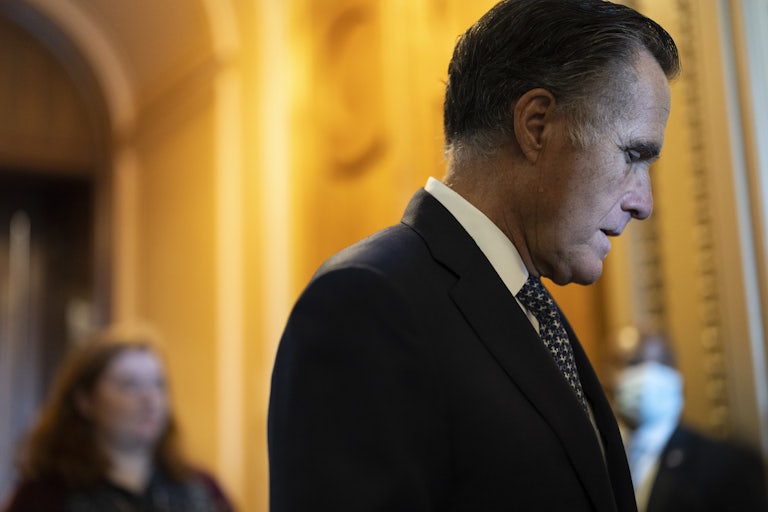
The Stupid Myth That Mitt Romney’s Mistreatment Gave Us Trump

Some conservatives argue that the way Democrats pilloried the Utah senator in 2012 pushed the Republican Party toward Trumpism. They should take a long look in the mirror.

Mitt Romney
Anna Moneymaker/Getty Images
Utah Senator Mitt Romney

As the Republican Party descended headlong into Trumpism, one lingering question has doggedly remained a point of fascination for pundits and political analysts: Did they fall, or were they pushed? There is a long list of culprits blamed for sending the GOP past the point of no return, from Jeb Bush to Barack Obama; from the Citizens United decision to gerrymandering. Nixon, FDR—even Kim Kardashian has made this list. But on social media in recent days, we’ve seen a slight uptick in one popular version of the Trump origin story: Republicans were radicalized by the tawdry way liberals treated Mitt Romney during his 2012 election run.

I’m not normally interested in what a few people happen to be tweeting. But this is no mere passing fancy. The lore surrounding Republicans being forced into a psychotic break because Mitt Romney was treated indelicately has been around for a long while. As Vox’s Zach Beauchamp reported in 2020, “Many conservatives have embraced” the idea that “Democrats smeared the kind and decent Romney so brutally … that Republicans became inured to this kind of argument and convinced there was no advantage to playing nice anymore.… Call it the ‘look what you made me do’ theory of How We Got Trump,” Beauchamp writes.

It’s an alluring cop-out. It’s clear that many really want to believe it. But I have long memories of the 2012 election and its aftermath, and folks, these claims don’t add up.

Make no mistake: The people behind Obama’s reelection campaign did what they deemed necessary to win. Romney was mercilessly characterized as an out-of-touch plutocrat, a step back in the direction of the vulture capitalists who brought the economy down in 2008. Romney’s biggest problem was that this particular shoe fit a little too snugly.

But sure, the Obama team wasn’t pure as the driven snow during that campaign, and liberals didn’t exactly strive to be some model of decorum either. Obama fans dined out on lots of shallow, mean-minded stuff like Romney’s equestrian interests and the saga of his family’s roof-bound pooch. Obama and his allies had plenty of ignoble moments as well. Romney’s comment that he “liked to fire people” was ripped from its context and used to paint him as an unfeeling toff. Then–Vice President Joe Biden knew he was punching below the belt when he told the crowd at a Danville, Virginia, rally that Republicans were “going to put y’all back in chains.”

But politics, as they say, ain’t beanbag; most of this stuff was fairly normal, relative to presidential campaigns. Little of this particularly rose to the level of, say, the Swift Boat Veterans for Truth. One thing that came close was an egregiously mendacious ad by an Obama-affiliated super PAC that essentially blamed Romney for a steelworker’s wife’s cancer diagnosis and death, while Romney was running Bain Capital.

But when it came to doing Romney dirty, Democrats had some pretty strong Republican rivals. While Obama criticized Romney’s Bain Capital past, it was Newt Gingrich who released an entire documentary about Romney’s allegedly destructive tenure as the firm’s head. Over the course of four months in 2011, Bill Kristol wrote seven separate columns for The Weekly Standard about how much he disliked Romney and wanted a different candidate to wrest the nomination from him. The antipathy of conservatives dogged Romney throughout the campaign and prompted some of his worst moments: his weird insistence that he was “severely conservative”; his infamous call for immigrants to “self-deport” themselves; and his quest to earn the endorsement of Donald Trump, who was then at the height of his reign as King of the Birthers.

In the wake of the Bain Capital cancer ad, campaign spokeswoman Andrea Saul went on television to defend Romney and, along the way, said, “To that point, if people had been in Massachusetts, under Governor Romney’s health care plan, they would have had health care.” This was a huge mistake. Saul was subsequently pilloried by conservatives for defending him by invoking such a (gasp) liberal achievement—by that point, Obamacare was the law of the land and it was verboten for Romney to mention his Massachusetts health care innovation. Romney was even forced to cut a line from his book about bringing that reform to the entire nation.

This was perhaps the greatest wrong done to Romney. The entire reason he had emerged as a presidential contender among Republicans was because he understood that there were problems that needed solving and that conservatives needed to compete with liberals in a war of ideas to solve them. Romney may be the only Republican in Washington who’s actually notched a recent major policy accomplishment that was celebrated across partisan lines: His Commonwealth Care was an example of this brand of politics; when there were enough Republicans interested in co-opting liberal issues and beating Democrats to market with solutions, Romney was top dog. He won the Conservative Political Action Conference straw poll four times between 2007 and 2012. But as I wrote in 2012, the party turned on him: “For all of the grief that Romney has taken for his multitude of flip-flops over the years, those are not, collectively, as damaging to Romney’s ambition as the way the Republican Party has flopped on him.”

Conservatives may want, even need, this ersatz martyrdom of Mitt Romney to exist to explain away their Trumpian turn, to spin the story that liberals’ treatment of Romney’s shortcomings gave them no choice. This all neatly forgets the fact that Republicans very much could have taken a second path but chose to abandon it. They sure have a funny way of treating their martyr, though. In 2020, CPAC chairman Matt Schapp told Greta Van Susteren that the four-time straw-poll winner would not be physically safe if he attended the conference. The fact is that Republicans have long been, and continue to be, Romney’s most dedicated persecutors. And through their persecution of him, they gave themselves permission to make their radical turn a long time ago.


This article first appeared in Power Mad, a weekly TNR newsletter authored by deputy editor Jason Linkins. Sign up here.
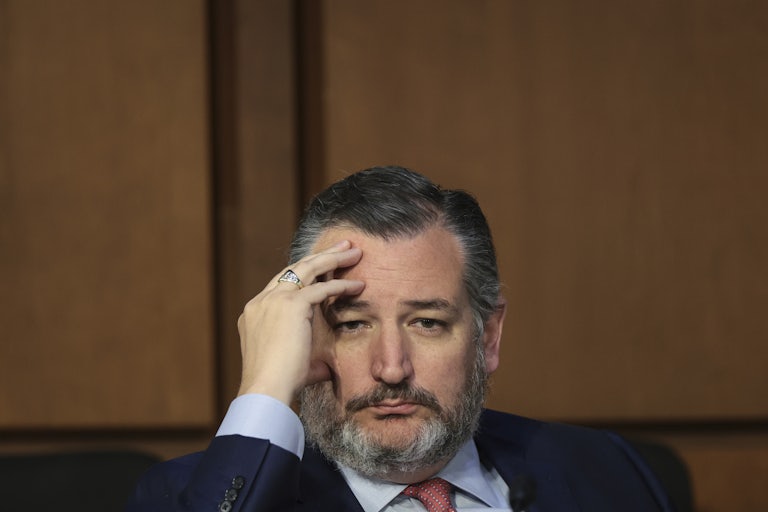
With a Single Word, Ted Cruz Gave the Game Away About the Right-Wing Supreme Court

The Texas senator’s recent complaint about the Inflation Reduction Act accidentally told the truth about the court’s war against the administrative state.

Win McNamee/Getty Images
Texas senator Ted Cruz

“Did the Inflation Reduction Act quietly save the administrative state?” That’s the big question that TNR’s Kate Aronoff took up this week after The New York Times and others reported on an eye-catching bit of fine print in the Inflation Reduction Act, or IRA. Running through the legislative text is language that “define[s] the carbon dioxide produced by the burning of fossil fuels as an ‘air pollutant.’” The detail may seem minor, but its inclusion could be a “game changer,” designed “specifically to address the Supreme Court’s justification for reining in the EPA” in last term’s West Virginia v. EPA decision, at least according to the Times’ Lisa Friedman. 

As we’ve noted on these pages before, the high court’s conservative bloc has recently ramped up its war against the administrative state. To that end, it has demonstrated a propensity for disallowing executive branch agencies from having the broadest possible latitude in interpreting the legislative branch’s instructions. So the way the IRA defines carbon dioxide in this explicit fashion, in the Times’ telling, is a defense against these judicial dark arts. 

This language shift didn’t go unnoticed by conservatives, and it elicited a very curious response from Texas Senator Ted Cruz, who said, “It’s buried in there … the Democrats are trying to overturn the Supreme Court’s West Virginia v. EPA victory.”

But as Aronoff explained, the mere existence of this language in the bill’s text doesn’t actually repeal anything. The Supreme Court’s decision in West Virginia v. EPA still stands, and its larger implications should remain a cause for worry. But even if including this revised definition of carbon dioxide doesn’t overturn a Supreme Court decision, it might herald the overturning of a school of thought among liberals on how to confront the court, and signal that Democratic legislators intend to apply some more strategic thinking to the challenges posed by the court’s conservative majority.

Cruz’s statement was a moment when the mask slipped. It’s rather unusual to characterize a Supreme Court decision as a “victory.” It’s a weird thing to say about an allegedly august institution that bills itself as a neutral caller of ball and strikes as it interprets the Founders’ intentions and sorts through a body of legal precedent. It’s like saying that the umpires defeated the Houston Astros in the 2021 World Series. And as MSNBC’s Steve Benen notes, Cruz was being oddly salty about congressional lawmakers simply doing their job: using their majority to pass laws. “I understand that Cruz disagrees with the underlying policy,” writes Benen, “but why take issue with a democratic governing process?”

In this case, I think the Texas senator’s complaints fairly neatly expose what’s at work: Cruz sees the high court’s conservative majority as a “victory” in an ongoing ideological project. And he’s not wrong—that is precisely how the court’s conservative bloc see it as well. Their end goal has long been apparent: They want to kneecap Congress and install themselves as an unelected superlegislature with veto power over the executive and legislative branches. 

What makes the “administrative state” work is the interplay between these branches. Traditionally, the Supreme Court has granted the executive branch agencies broad discretion to interpret laws, which allows them to be nimble as the times change but the laws don’t. As I’ve previously noted, “An EPA that couldn’t rely on that leeway would need Congress to constantly pass new laws directing it how to proceed on every matter in its purview and then pass additional new laws covering the same ground as circumstances changed.” 

The IRA’s revised definition of carbon dioxide won’t thwart the Supreme Court’s conservatives, but it demonstrates that Democrats on Capitol Hill are taking their threats more seriously. As frequent TNR contributor Simon Lazarus tells me, “The most important takeaway from the IRA provisions is not exactly what they say, or how they will strengthen arguments against, for example, the court deploying the major questions doctrine to overturn important new EPA actions. Rather, what is important is the political fact that Democrats acted at all to take on [a Supreme Court] intent on micromanaging Congress and executive agencies and in the interest of Republican agendas and interests—in particular, the priorities of Republican megadonors who also happen to have funded the justices’ ascent to the power they now possess on the court.” 

This week’s news augurs something of a sea change, in which Democrats are alert and alive to the challenge and have started to think more strategically about countering the conservative judicial movement. This is long overdue. Back in 2021, President Biden asked a White House commission to weigh various ideas to reform the Supreme Court during a time of grave concerns about its legitimacy; the commission’s report offered scant solutions. As recently as July, there were concerns in liberal circles that Biden was failing to meet the problems that the Roberts court presented head-on.  

As Lazarus wrote in these pages back in June, liberals “must embrace a hybrid genre of political-legal combat,” discredit the legal arguments of the conservative bloc, and advance new and novel legal arguments of their own. The language in the IRA that’s being touted by environmental advocates may be the first stirrings of this larger battle. But at the very least, we can all finally acknowledge the facts as Ted Cruz understands them: The Supreme Court’s conservative justices are ideological actors, through and through. 


This article first appeared in Power Mad, a weekly TNR newsletter authored by deputy editor Jason Linkins. Sign up here.
The Democrats’ Case for Reelection: Order Over Chaos

The biggest contrast the Democrats can draw over the next two years is that while they have passed a slew of major legislation, the Republicans have further descended into mayhem.

Demetrius Freeman/Getty Images
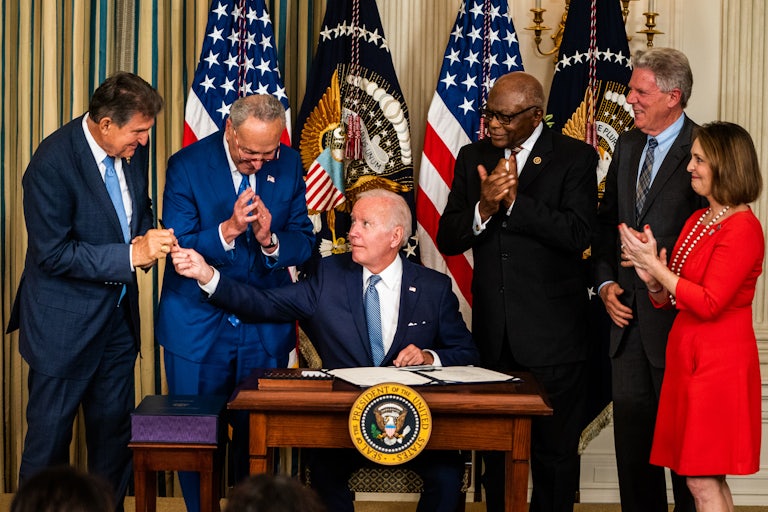
President Joe Biden signs the Inflation Reduction Act into law.

As I noted last week, the FBI’s raid of Donald Trump’s Florida redoubt spurred Trump’s defenders into a frenzy of hot anger, the onrush of which, as my colleague Matt Ford noted, may have been a wee bit premature, given the revelations that quickly emerged. But the reaction has been just as exuberant from the left. Merrick Garland, who’d up until then been a fixture of impatience and discontent among liberals hoping he’d apply a more Javert-like zeal to his pursuit of Trump, was suddenly an unlikely meme hero. After an interminable wait for the Justice Department to put Trump in a legal bind, Dark Merrick had finally did it on’ em.

But while the outpouring online is understandable, I’d urge Garland’s newfound fan base to follow his lead. As I previously noted, the straitlaced, even dull, persona he’s created for himself hasn’t lent itself to spectacle or emotional catharsis. But it’s been a great tone for the leader of an agency in bad need of a restoration to set. This is an excellent opportunity to embrace the Garlandian virtues of dull normalcy. Between now and the next presidential election, Democrats should do whatever they can to Make America Bored Again. What was the point of a Biden administration, anyway, if not the total assertion of a dull, normie, incremental political aesthetic as one of the better alternatives to four incompetent and cruel years under Trump?

Order is not something that Biden has always successfully established or maintained: His withdrawal from Afghanistan was more haphazard than it should have been; the road out of the pandemic has been and continues to be rocky. In recent weeks, however, Biden’s manifested a more serene vibe: His party, at long last, came together to pass a legislative agenda after a year of discord. The Inflation Reduction Act may be the balm for what’s ailed a fractious party that sparred over the Build Back Better Act.

Compared to Build Back Better’s top lines, the IRA looks like a picture of moderation. But as TNR’s Michael Tomasky notes, it’s also quietly revolutionary at its core. Newly signed into law, the IRA “begins to turn 40 years of bad economic conventional wisdom on its head by asserting that the government has a role in structuring markets, promoting growth, and guiding industrial policy,” Tomasky writes. The ship of state is being gently steered into better waters; those Democrats who fought for better and more generous policies now have a much firmer foundation from which to make new demands as a result. Coupled with Biden’s throwback views of the labor market, this means Democrats now look like a more cohesive and united party, and they’ll be able to campaign on an economic message with real possibilities.

Meanwhile, the GOP has embraced an all-havoc, all-the-time platform. Post-Roe America is turning out to be a nightmare in all the ways that liberals warned. Political violence is becoming more prevalent and more obviously a product of right-wing ideology. GOP candidates are growing stranger and more alien by the day. Conservatives are banning books and threatening children’s hospitals. And the party of Lincoln has torn down its monuments to the sixteenth president and erected busts of Hungarian autocrat Viktor Orbán in their place. Stem to stern, the GOP is sailing with a full complement of unreconstructed chaos agents.

Naturally, one of the ideas that those chaos agents are raising right now, as the investigations into the former president’s dealings advance on multiple fronts, is that the very act of bringing Trump to justice could plunge the country into turmoil. It’s an argument that Trump, in particular, hopes will be convincing, if only to save his own skin. And as The Washington Post’s Paul Waldman and Greg Sargent report, it’s also an argument that’s finding some purchase in the discourse, as media elites wonder if Garland shouldn’t try to tamp down the tense situation.

But as Sargent points out, those tensions exist only because of “GOP demagoguery,” and it’s not Garland’s “job to shape the legal response around GOP noisemaking.” Besides, the long-term chaos caused by creating a culture in which no one is held accountable outstrips the short-run chaos of a news cycle in which the dumbest pundits in the land demonstrate how susceptible they are to right-wing propaganda.

Democrats have the opportunity to draw an important contrast to the Republican vision of America, and the calm sobriety that Garland has recently projected is a model for Democrats to follow. Not long ago, I proposed that Democrats should promise voters that they’ll fight for the Good Life—a pledge to deliver more shared prosperity, more widely distributed political power, more political stability, all to allow all Americans to have more time to spend with the people they love. Chaos is the enemy of this agenda. This is a ripe time for Democrats to make a big bet that there are more people out there who want a calm and prosperous country instead of an unruly one.

Editor’s Pick of the Week

The Slandering of Merrick Garland

The right’s spent the better part of the week trying to paint the attorney general as a despot. Those charges won’t stick.

Evelyn Hockstein/Getty Images
U.S. Attorney General Merrick Garland

One of the most compelling things about Merrick Garland is how fundamentally uncompelling he is. Back when then-president Barack Obama nominated him for the Supreme Court, he was tapped because he was an uncontroversial choice, all the better to win some votes from Republicans. (Things, obviously, didn’t go according to plan.) Now, he’s possibly the least charismatic member of the Biden Cabinet. The least photogenic as well: I can tell you firsthand what a struggle it is to find an interesting photograph of him. None of these traits seemed to be particularly advantageous—until, perhaps, this week, when the unassuming figure signed off on a warrant for federal agents to search Mar-a-Lago, President Donald Trump’s post-presidential way station.

It wasn’t immediately clear what exactly the Department of Justice was looking for at Trump’s resort. Most of the reporting on the matter suggested that the warrant pertained to the president’s alleged mishandling of classified materials, which The Washington Post later reported included “documents relating to nuclear weapons.” Garland confirmed this on Thursday afternoon and proceeded to ask for the warrant to be unsealed; The New York Times reported earlier in the day that the DOJ sought to recover those materials with a subpoena long before the warrant was executed. It’s also worth remembering that just because a warrant gets served, that doesn’t mean arrests or indictments are necessarily in the offing.

But what the subpoena news demonstrates is how unlikely it is that Garland or other high-ranking federal law enforcement officials would escalate in this manner without a good reason—and remember, a judge must also agree that there is just cause to serve a warrant. If those who sought and issued this warrant don’t have their ducks in a row, then the blowback will be intense. At the same time, even if everything was done by the book, the politicization of the whole fracas means that blowback is inevitable regardless.

But it’s here where Garland’s bland persona may serve him. There are many things you can say about him, but it’s a real challenge to characterize him as some sort of partisan firebrand. Indeed, for the bulk of his tenure, his seeming lack of passion for pursuing Trump with a Tommy Lee Jones-like zeal has left liberals vexed. Last October, California Democrat Adam Schiff, who played a leading role in Trump’s impeachments, said that he was in “vehement” disagreement with Garland’s seeming reluctance to hold Trump accountable.

As TNR’s Matt Ford has pointed out more than once, Garland never promised to be a Democratic avenger, nor has he at any time cultivated such a persona. What he has successfully communicated is that the Attorney General’s office would not be defined by some monomaniacal pursuit of Trump. The biggest task for Garland when he assumed office was the revival and restoration of the DOJ as a functional and independent institution after the wayward tenure of his predecessor, Bill Barr, during which time it really did seem like the DOJ could become a private tool of executive branch retribution.

It won’t be possible to escape the politicization of a DOJ investigation into Trump; some matters are beyond Garland’s control. But let’s note how Trump’s allies are responding: They’re foaming at the mouth about Garland being a corrupt autocrat whose actions are like unto dictatorships. As MSNBC’s Steve Benen pointed out, the seeds of this Garland smear campaign were planted long before federal agents descended on Trump’s resort. The GOP anticipated the possibility of further and more serious legal tribulations for Trump, probably because they have intimate knowledge of just how bad his misdeeds were.

But it’s going to be hard to make such a characterization stick to Garland. In dictatorships, government officials don’t serve search warrants or seek the permission of judges to carry out seizures; they don’t offer you a chance to amiably resolve the dispute in advance; they don’t give the people they’re trying to suppress a chance to make their case in public; they don’t assert the presumption of innocence or provide a forum for the accused to prove their case. More to the point, they don’t wait years to punish their political opponents. Indeed, Iraqi dictator Saddam Hussein, who Republicans might recall, undertook a violent purge of his government six days after taking power in what’s colloquially remembered as the “comrades massacre.” That’s a far cry from how Garland behaved, no matter what Republicans might allege.

What’s more, the only people talking about purges and political violence are Republicans. Trump is the one planning a mass dismissal of government bureaucrats if he’s reelected. And if you want to hear someone promising the dawn of autocracy, look no further than Florida Senator Marco Rubio, who in the wake of l’affaire Mar-a-Lago issued a not-so-vague threat: “What comes around goes around. And here’s what’s gonna happen now—one day they won’t be in power. And whoever is in power, there’s gonna be a lot of pressure on them to do it back to the other side. And now we do become a banana republic.” This is a pre-confession; in this scenario the “whoever is in power” is—according to Marco Rubio—Marco Rubio.

I almost feel bad for Trump’s allies, all of whom have spent the past half decade in a ruthless, backstabbing reality show about the sunk cost fallacy. But here’s the scoop: The guy is a corrupt dude who does crimes. By now, if you’re backing him, it’s because you’re itching to serve under the thumb of a caudillo; you are actively seeking political bloodshed and the disintegration of the Founders’ ideals. There are plenty of people on hand, right now, scratching and baying to become handmaidens to autocracy. Merrick Garland isn’t one of them.

This article first appeared in Power Mad, a weekly TNR newsletter authored by deputy editor Jason Linkins. Sign up here.

Latest From Politics